Tag Archives: Horror on the Orient Express

Other times, other Expresses II

We’re looking here at more brave, insane or intrepid individuals who have lovingly recorded their experience of running or playing Horror on the Orient Express.

Clicking any of the links below will reveal spoilers.

Bret Kramer’s blog post Memories of the Orient Express  on his blog, Tomes in Progress,  is indeed just that. He reminiscences about running the campaign through a nostalgic haze of 20-odd years, and casts a dispassionate eye over the foibles of players, Keepers and writers alike.  He also has a ton of other Keeper aids and hand-outs, and is one of the movers behind the long awaited Masks of Nyarlothoptep Companion.

Call of of Cthulhu, or Constantinople or Bust is an endearing diary version of one gang’s train journey, told in diary format by the different characters and complete with appropriately movie star photographs of the cast. I particularly like a photograph they unearthed for the Sofia  scenario. Thank you Simon, for your brave sacrifice. We fellow soldiers in the Trenches of Horror salute you. 

Simon's Eyeball [Cthulhu or Bust]

Simon’s Eyeball [Source: Constantinople or Bust]

Another 1920s version by Leonard Bottleman starts in the single calm narrative voice of Franklin Meyers, as a recap to the now scattered investigators.  However by the time the team reach Belgrade, different narrators, and a strong hint of panic, emerge. The story includes the maps and characters from the scenarios  as an aid to the reader, and as always I am in awe of how so many Keepers found so many ingenious ways to plug plot holes and keep things moving and entertaining.

Some Keepers have cleverly translated the campaign out of its 1920s roots.

Gaslight diary sets the story in 1890, and was played as a World of Darkness campaign and recorded by Derek Morton. The account is The Diary of Tweeney Sodd  and it’s a note perfect rattling easy Victorian pastiche, but its writers have used white writing on black background rendering the entire story into squint-o-vision. Copy and paste, readers, to enjoy such gems as: “I am not sure what was going on but Nigel had brought his shotgun with him.”

Yellow Dawn Session notes is a cyberpunk take on the Express by the seriously talented and deeply weird David J. Rodgers. It takes the Express to a sanity stretching Sofia. It also features a very classy image of the head of the Sedefkar Simulacrum.
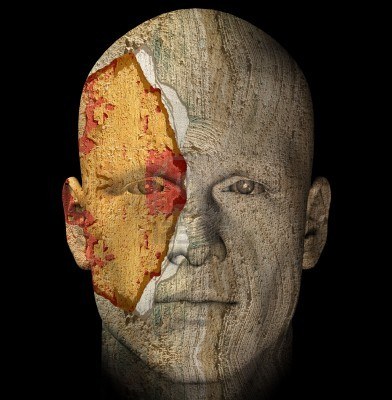
Head of the Sedefkar Simulacrum Statue – image by sirylok

Head of the Sedefkar Simulacrum Statue – image by sirylok

So the train steams ever onward into new worlds of fantasy and imagination.
4 Comments

Filed under Guests, Writing

Other times, other Expresses

We’re excited that Horror on the Orient Express has taken on a life of its own. People like it. They write about it. They create new stories and they ride the train in other times and other places. Here are a few of the brave souls who have recorded their experiences online.

Yog-Sothoth.com is a community created by Paul of Cthulhu for online discussion and friendship centered around Call of Cthulhu. It is a great place to discuss the game with fellow Keepers and frequently authors from all companies producing licensed Call of Cthulhu material. Almost all started as fans first, and writers second. Forums are clearly organized according to your Cthulhu-of-preference, Gaslight and Classic, Ancient, Modern, and all other theatres of horror.

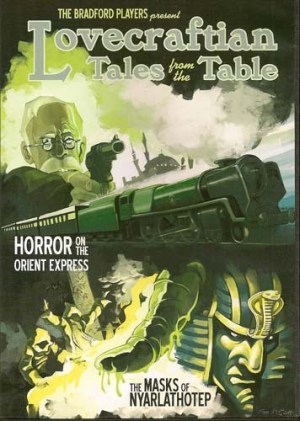
The particular strength is the podcast recorded by Paul and friends, or Yog-radio as they style it. Years ago, the Bradford Players sat down to play through Horror on the Orient Express in its entirety, and they recorded the playthrough in surround-sound. It’s like a radio play with occasional dice. It was also collected as Lovecraftian Tales from the Table, which also includes their playthrough of Masks of Nyarlathotep as well as tons of nifty extras such as props, trailers, music and more, including interviews, one of which is with the nefarious trio of Richard Watts, Geoff Gillan and Mark.

The characters played by the Bradford Players during the audio playthrough will be included as NPCs or even replacement investigators in the Strangers on the Train section of the new edition of Horror on the Orient Express.

Lovecraftian Tales from the Table

Lovecraftian Tales from the Table (Yog-Sothoth.com)

 The radio play inspired Nick Marsh to create a novelization, The Express Diaries. This is a superb hardcover, illustrated by Eric M. Smith and a wonderful map by Steff Worthington. The format of the novelization is in diaries and letters.

The Express Diaries (Nick Marsh)

The Express Diaries (Nick Marsh)

When not recording bad things happening to good people on fine trains, Nick Marsh is a vet. He has a writing website which links to his amusing blog, Maybe It Should Happen To A Vet.

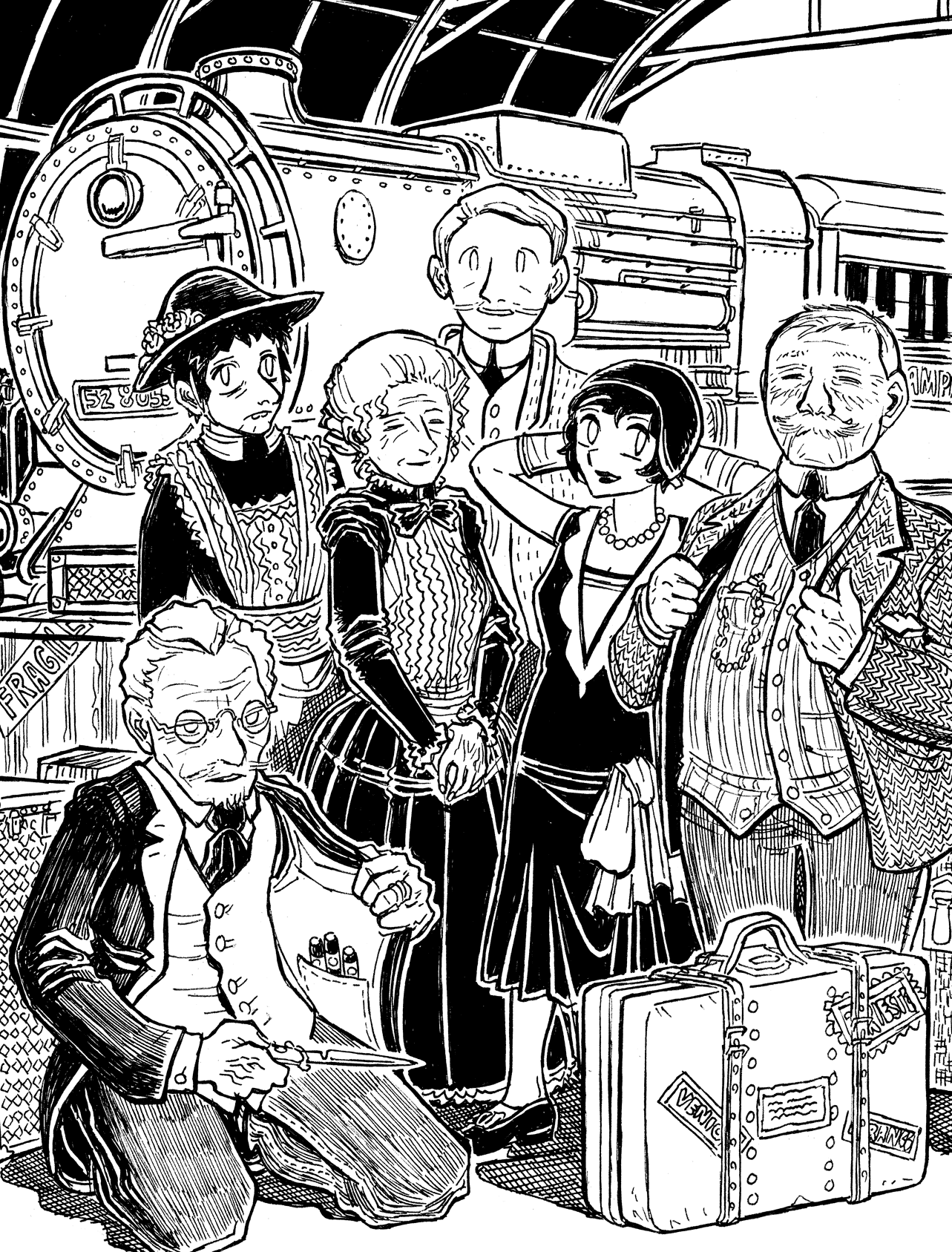
Finally, comic artist Jason Thompson was inspired by the podcast to do some marvelous illustrations of the characters. Jason has also illustrated Dream Quest of Unknown Kadath so he is all right by us.

Sketch of the Bradford Players characters by Jason Thompson

Sketch of the Bradford Players characters by Jason Thompson [Source: Mockman.com]

All of this activity started with our train but really is the triumph of Paul Maclean, and everybody who posts, blogs, discusses and occasionally rants at Yog-Sothoth.com.

Leave a comment

Filed under Fun, Writing

Period photos galore

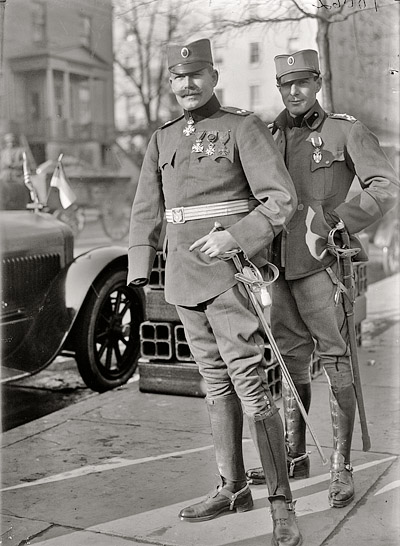
Serbian police [Source: Horror on the Orient Express blog]

The photo above comes from Wolfram’s splendid Horror on the Orient Express blog. Bookmark it right now, and go there often. Wolfram is looking forwards to running the campaign, so he is amassing period photos and posters, and collecting them all together so that everyone can benefit. So, do take advantage of his good work. Many thanks to our friend Jeff Carey for sending this one our way. He found it while prepping the luxury playthrough he is presenting at GenCon for our exceptional backers.

The photo is timely for this week’s playtest. The investigators are in Vinkovci in the Kingdom of Serbs, Croats and Slovenes, and the town is filled with Serbian police intent on finding the perpetrators of a recent outrage. Oscar Rios has outdone himself with this scenario. Listening to the criticism that the 1991 campaign is too linear, he has crafted a piece with so many different strands of investigation that the players have no shortage of things to do. They’re loving it.

Thanks Oscar. Thanks Jeff. Thanks Wolfram. We love our new international community of train friends!

Leave a comment

Filed under Library Use

Easter Horror on the Orient Express

Horror on the Orient Express takes place in January and February 1923, and Good Friday was on 30 March in the same year. Thus the train is eternally steaming towards Easter but never actually reaching it, which is a pity because the story is very much about rebirth and reincarnation, shedding, as it were, our human skin.  

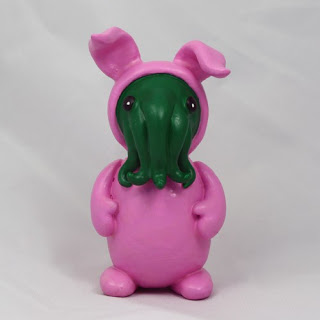
To celebrate the season I did a real quick web search for Cthulhu and Easter memes. I surfaced pop-eyed and clutching a fistful of Cthulhu bunnies.

Cthulhu as Easter Bunny

The horror…the horror… [Source: The Lovecraftsman]

I’ll be sure to thank all you energetic hobbyists just as soon as my eyeballs stop bleeding.

When horror becomes kitsch we all know the end times are nigh, although I guess what with Cthulhu cakes and Cthulhu furries we collectively splintered through that barrier a long time ago. Stop it people! For God’s sake you know not what you do. Or perhaps you do… If we mock and trivialize horror it loses its insidious power. Only when the lights are on of course; in the dark and alone, are you really sure the glassy eyes of that plush Cthulhu doll aren’t following you round the room?

Easter is, naturally, all about pagan fertility symbols. Shub-Niggurath seems the obvious fertility goddess of the Lovecraftian canon, although she rarely is mentioned beyond the standard invocation: Iä! Shub-Niggurath! The Black Goat of the Woods with a Thousand Young! (Poor Shub-Niggurath, typical superannuated female deity; the male gods take all her real power and she’s left with a placating prayer to keep her happy.)  On that note, in Horror on the Orient Express, the Belgrade chapter is even now being re-written so that… I’m not allowed to say… but just look at the start of the paragraph and fill in some holes.

However, a post-Freudian argument can be made for Cthulhu being the true symbol of renewal and fertility, albeit birthing destruction and chaos instead of redemption. There are some interpretations of  Great Cthulhu as a giant, walking uterus. This may be a useful metaphor for those who wish to delve into Lovecraft’s psyche and explore the subconscious forces that drove him to write, but I don’t think it helps us understand why we continue to enjoy the stories. Why?

We enjoy them because they scare us and we like to be scared. They scare us because they posit malevolent creatures of deity-level power inhabiting an uncaring universe in whose chinks humankind survives only because we are so insignificant we have not yet been noticed. This is a terrifying and nihilistic vision that no other writer of horror has ever evoked so completely, and it is unique. Cthulhu may be born of the subconscious fears of one man’s id, but that fear was reshaped as a terrifying and primal force that can still reach out and touch us with the very tip of one cold slimy tentacle today, decades after the stories were first written.

How’s that for a Happy Easter?

Lovecraft's sketch of Cthulhu

Lovecraft’s sketch of Cthulhu. Note lack of bunny ears. [Source: Wikipedia]

1 Comment

Filed under Fun

Coffee of Cthulhu

The black brew

Ph’nglui mglw’nafh Cthulhu R’lyeh wgah’nagl espresso

So, this is the black brew that will keep ye Editor going between now and submission date. I thank the kind relatives who donated this set-up to me a few months ago; without this I’d be a smouldering pile of Essential Saltes by now.

I am not alone in my slavery to the bean. Oscar Rios is another famously caffeinated author, who is using the dark beverage to power him through many a pre-dawn editing session as he finishes a killer trilogy of rewrites:  Sofia, Invictus and Vinkovci. I can’t wait to unleash them. The Invictus session last weekend was gruesome fun, and my 1920s players reach Vinkovci this Thursday for an unexpected stop and a whole lotta horror.

Coffee, Rios style. [Photo: Oscar Rios]

The prospect of finishing up on Horror on the Orient Express has not inspired Oscar to take a well-earned rest; instead, he’ll be making many a pot of coffee to keep him going as he launches Golden Goblin Press, his own publishing imprint. His first release will be Island of Ignorance, the Third Cthulhu Companion.

The Cthulhu Companion [Chaosium, 1983]

I have such strong and happy memories from the 1980s, buying The Cthulhu Companion (wow, I thought, that guy is never getting out of that well…) and Fragments of Fear (zombies! cool…)

Fragments of Fear [Chaosium, 1985]

I can still clearly picture the layout of the store where I bought them (the Games Shop in Royal Arcade, Melbourne). The store is still there 30 years later, still cozy, but it’s all Catan and Scrabble and jigsaws these days (not that I am complaining; my Deluxe Scrabble from there was a great surprise Christmas present, even though I have yet to drop SQUAMOUS on a Triple Word score).

Looking over the contents again now, I see that The Cthulhu Companion features a Mythos creature who gets a starring role in one of the chapters of Horror on the Orient Express, so it was inspirational in more ways than one.

Island of Ignorance [Golden Goblin Press, forthcoming]

I look forwards to that same thrill when I get my copy of the Island of Ignorance, the Third Cthulhu Companion later this year, and see what Oscar and his coven have cooked up. I’d love to be part of it, but I have a train to catch.

To keep in touch with Oscar’s Cthulhu happenings, follow his excellent blog Minion of Cthulhu.

Leave a comment

Filed under Writing

Revisiting Venice II – The Scenario

Beware, here be spoilers…

Re-visiting the Venice scenario made me think about the reasons why I structured it as I had. It has three strands, Love and Death, and then the Mystery, the results of the players’ investigations. On re-reading the scenario I was shocked by two things. First, my unthinking stereotyping of Italians as cheerful incompetents, for which I’d like to unreservedly apologize to the entire nation.  Second, the Venice of my imagination provided excellent background and color but it had a complete lack of actual plot – just keep knocking on those doors, players, eventually you’ll find the right house. What worked well was that the incidents of Love and Death ticked over regardless. There was always something going on in the background which the investigators could choose to investigate.

I was baffled by why I had divorced the Love sub-plot from the actual plot, until I remembered why I’d written it in the first place. In Lausanne and Milan, the players meet characters they cannot help. We wanted to restore their belief that they could save someone. This, after all, is the reason they first boarded the Orient Express. Thus, Love came in. It certainly worked a treat in the play-test. When one of the play-testers suggested not helping the lovers he was thoroughly rounded on; ‘Good God man, we’re British’ was firmly remarked.

It was clear that in my re-write I had to leave Love and Death alone and focus on building an actual plot, as well as allowing the non-player characters some more actual, well, character. Fortunately twenty additional years of writing experience have given me a few more clues on how to structure a narrative.  I’ve now moved the thing the players are trying to find around, although never fear, Dear Readers, it still ends up in the same place. I have created a trail of clues to follow, and made one of the NPCs a disabled war veteran (guess what Keepers, he has an artificial leg). In Venice the players also find a clue that sends them to Constantinople at the time of the Fourth Crusade. I feel that Venice now has more than enough plot to go on with.

It is also clear to my older self the deadly nature of the conflict between the Communists and Fascists, which my younger self had unthinkingly played for laughs. One of our play-testers is a historian, and he unearthed the following newspaper clipping. These events precede our scenario by only a few months. There are deep divisions in Venice, in all of Italy, that will only get worse.

Christmas Day fight December 1922

Christmas Day fight December 1922 [Source: Kalgoorlie Miner 29 Dec 1922, retrieved from The National Library of Australia, trove.nla.gov.au/ndp/del/article/93236637]

3 Comments

Filed under Spoilers, Writing

Need more bulldog clips

Orient Express manuscript pile

So this is what a four-inch high pile of Orient Express manuscript looks like.

Bottle of Glenfiddich included for scale, and for editorial courage.

2 Comments

Filed under Writing

Revisiting Venice I – The City

So Mark’s play-testers have survived Venice, and are on to Trieste. As one player astutely observed, the real hero of the scenario was Venice herself.

I’ve re-visited Venice both in metaphor and in reality. I hadn’t been to the city when I wrote the scenario twenty odd-years ago. I had read John Julius Norwich’s A History of Venice, and I had always vowed to visit before I was thirty. I managed it, just.

Before I left my mother gave me a wonderful gift, picked up in a second hand bookshop, E.V. Lucas’s A Wanderer in Venice. E.V. Lucas wrote his guidebook to Venice in 1914. Aside from the Austrians no longer sunbathing  on the sands of the Lido, his lively tome is still an excellent guide. I could retrace his steps, see what he had seen, and count the winged lions along the canals at his side.

Lucas and Norwich generously gave me their Venice and their views still colour mine today. It was a city born of the printed word and pictured firmly in my imagination before I ever saw it in reality. And unlike most visions born in this way Venice was even more beautiful than I imagined.

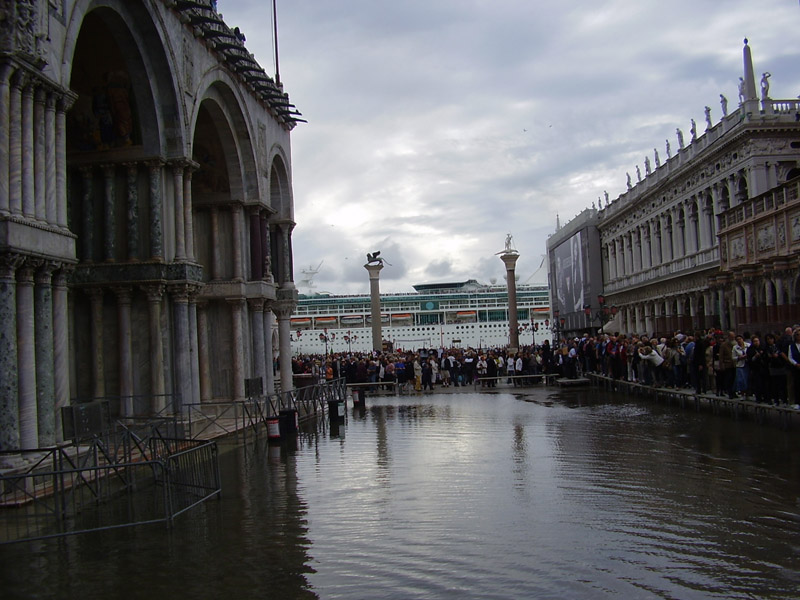
Sixteen years later I re-visited Venice, this time with Mark. Venice is slowly sinking into its marsh. It had sunk several more centimetres by then, so at high tide St Mark’s Square was awash and the sea crept into the entry of the basilica.

St Marks at High Tide

St Marks at high tide

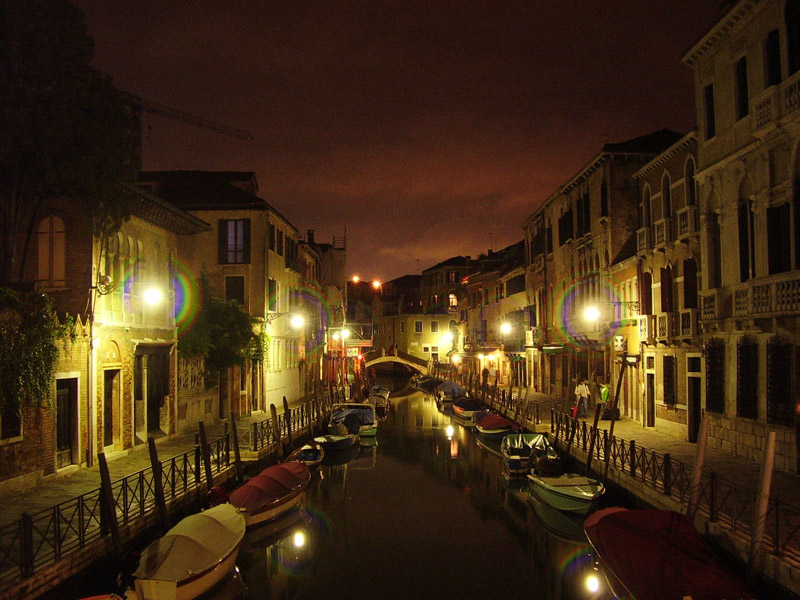
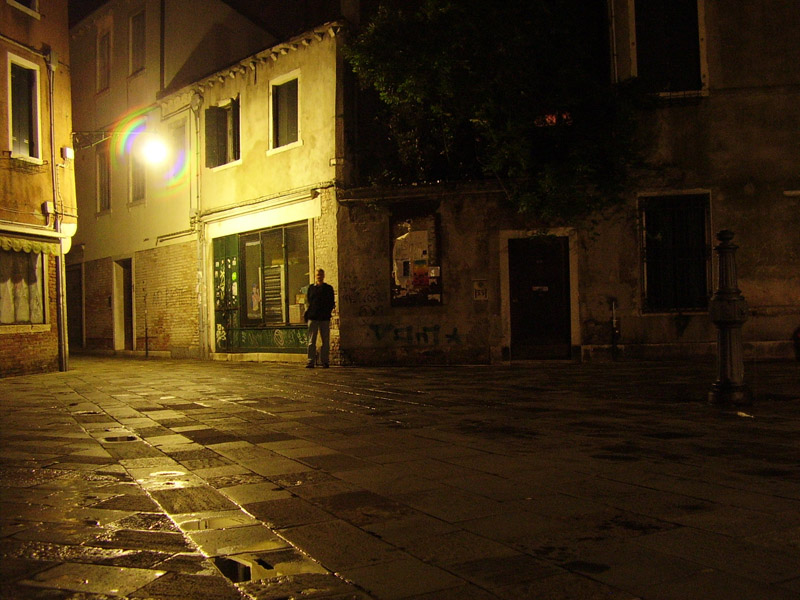
The city seemed to be losing the fight against two equally remorseless foes: salt water and tourists (of which I was one). Its beauty was all the more heartbreaking. The atmosphere of this city is unique. At night all is quiet and dark, with only the lights reflecting on the canal water.

Venice canal at night

Venice at night

Mark in Venice at night

Who is that figure lurking in the Venetian darkness? Oh, it is only Mark.

Leave a comment

Filed under Travel

Opening night at La Scala

Looking at real places is always a help when running a scenario.  The Guardian website has a feature on opening night at La Scala, Milan. It’s a vivid and heartfelt look behind the scenes at La Scala, and  really sums up the central place the opera house holds in the hearts of the opera-l0ving Milanese. It will also give Keepers some ideas on how to run the Milan chapter of Horror on the Orient Express.

http://www.guardian.co.uk/travel/video/2013/feb/19/scala-opening-night-peroni-italy-video

Opening night at La Scala [Source: The Guardian website]

Leave a comment

Filed under Music

The Dreamlands Express II – The Bestiary of Dreams

When I was compiling the Dreamlands Express itinerary I thought about the fauna and flora of the Dreamlands and added it to the views from the train by way of local colour.

The fauna included Dreamlands fauna like magah birds, at least one animal of my own invention (from a dream in fact), and a smattering of real animals, mainly African. After all there are elephants and peacocks, yaks and zebras in the Dreamlands, so there must be a few other exotics tucked away. This had an unexpected side-effect. Just before Mark play-tested the Dreamlands Express scenario I found him leafing through the Dreamlands bestiary looking for quagga and okapi. I hadn’t realized it was possible to mistake these real world animals for dream beasts, but I guess their names do look kind of made up.

The okapi, a pleasingly defined “giraffid artiodactyl mammal”, is fortunately still with us:

What this okapi photograph doesn’t show you is that okapi tongues are so long  they can lick their own eyeballs  [Source: themagazine.ca August 2009]

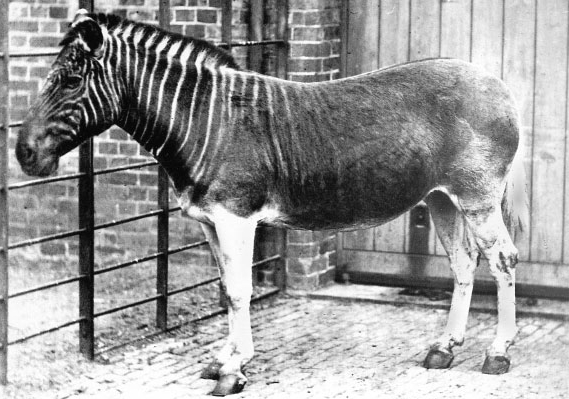
The quagga, alas, is not.

A South African sub-species of zebra, it was hunted to extinction in the wild. The last quagga died in an Amsterdam zoo in 1883. I included the quagga in the Sona-Nyl description because one of the few things we now know about the quagga – the sound of its cry – was described in a poem. As Robert Silverberg notes dryly in The Dodo, The Auk and the Oryx, it is not a good poem, but it gives us today this one useful fact. I thought that any animal immortalized in poetry should have a chance to live on in Sona-Nyl, the Land of Fancy.

Quagga in the London Zoo, 1870 [Source: Wikipedia]

The other important Dreamlands animal is of course the cat. Lovecraft loved cats and the Dreamlands was one of the few areas of his fancy where he could give this affection full play. I had great fun with a cat sub-plot on the Dreamlands Express, where cats have their own compartment and are treated as full passengers. If the dreamers ask about this, they are given reasons taken straight from Lovecraft’s DreamQuest and The Cats of UltharFor the cat is cryptic and close to strange things that men cannot see; for the Sphinx is his cousin and he speaks her language; but he is more ancient than the Sphinx and remembers that which she hath forgotten.

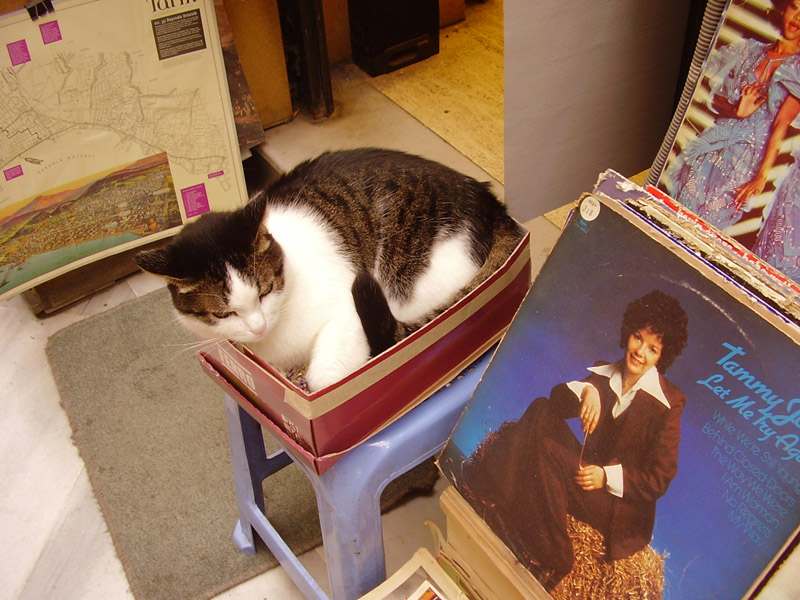
So in closing, here are some cats of Istanbul. Remember, they are looking out for you in their dreams.

Cat of Istanbul enjoying a carpet

Cat of Istanbul, ready to take a nap on a carpet

Cat of Istanbul enjoying a windowsill

Cat of Istanbul enjoying a snooze on a windowsill

Cat of Istanbul enjoying a box of records outside Lale Plak music shop

Cat of Istanbul napping in a box of records outside Lale Plak music shop

11 Comments

Filed under Writing