Category Archives: Travel

Posts about our own travels along the Orient Express route.

A Visit to Chaosium

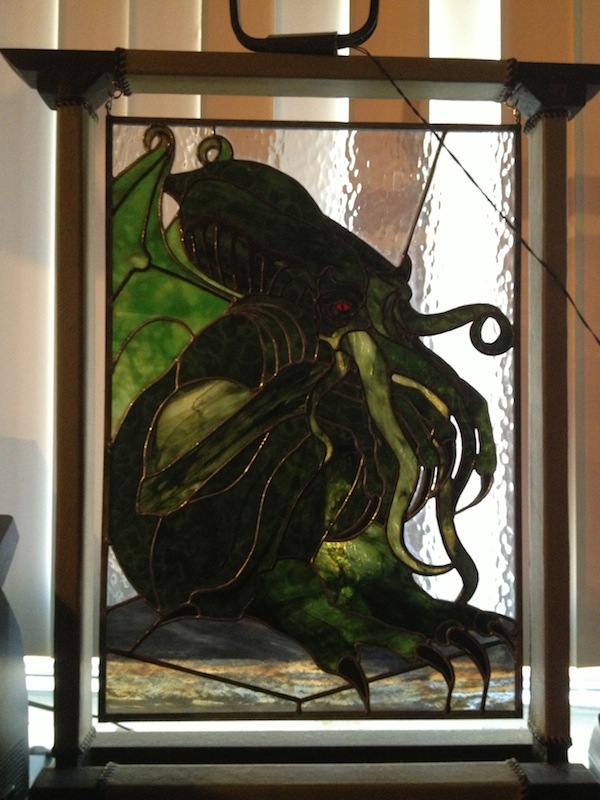
chaosium-cthulhu

Stained-glass Cthulhu at Chaosium

Penny and I have arrived in America on the first stop of our 2013 GenCon Horror on the Orient Express tour. We have even taken our first train, the BART (Bay Area Rapid Transit). It did not have  a salon car where white-clad waiters served champagne, but it did get us out to Charlie Krank’s place in Hayward from the airport. We’ve since been recovering from our jet lag, eating some amazing vegetarian food in the Bay Area and playing some games.

mark-at-chaosium

Back in the office at Chaosium, 2013

On Monday we visited the Chaosium offices, and for the first time saw a printout of the complete layout of Horror on the Orient Express, which Meghan has prepared to show everyone who comes to the Chaosium booth (#501) at GenCon Indy. It’s amazing to see the book printed out: a huge stack of paper larger than Beyond the Mountains of Madness. Meghan has done a fantastic job with the layout, and it was great to see the new art, particularly the new version of the Sedefkar Simulacrum, which is so blasphemous we can’t show you yet. We also met Nick, who showed us the Traveler’s Companion bound and printed up as a sample GenCon preview edition. We hope this little book that will be a useful player aid at the gaming table. It has a guide for each city on the route, accompanied by wonderful city maps by Steff Worthington.

We also got to go to the all-new expanded wing of the Chaosium warehouse to see boxes and boxes of Orient Express loot: T-shirts, medallions, commemorative coins, placemats, matchboxes, mugs, coasters and more. Chaosium have been sending out photos of all the merchandise as part of the Kickstarter updates, but it’s another thing again to see a massive wall of boxes. There’s so much stuff there you have to scale the front stack to get to the stack behind it.

OE-boxes

Boxes and boxes and boxes of Orient Express swag

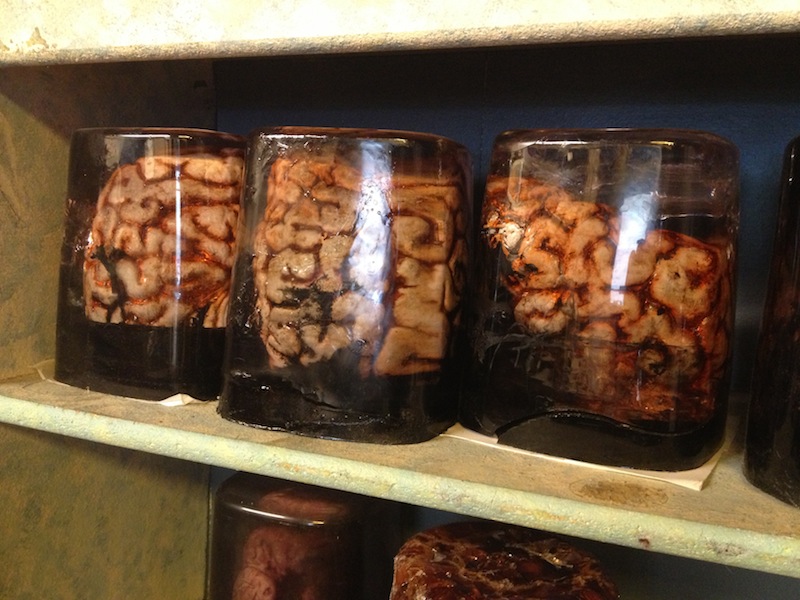
The nearby row of mi-go brain cases made me wonder what if that’s what happened to previous writers who missed their deadlines, because I flubbed a few.

Assuming the vacant space on the bottom right is not reserved for me, we leave on Tuesday for the real world gibbering madness that is GenCon…
migo

Mi-go brain cases

1 Comment

Filed under Chaosium, Conventions, Travel

Capturing Lovecraft Country

This week, I’m featuring some atmospheric photographs from our 1990 New England trip, accompanied by quotations from the Lovecraft  stories in which the location appears. So get ready to snuggle in and enjoy the scenes with a cup of cocoa, and do make sure the door is closed, and locked, behind you. It was closed, wasn’t it, a moment ago?

The Haunter of the Dark 

Of all the distant objects on Federal Hill, a certain huge, dark church most fascinated Blake. It stood out with especial distinctness at certain hours of the day, and at sunset the great tower and tapering steeple loomed blackly against the flaming sky. – The Haunter of the Dark

Haunter-of-the-dark

St John’s Church, Providence (Starry Wisdom Church)

St John’s was demolished in 1992. Although I quite like the out of focus photograph, as if a  pictorial hint that all is not well, I regret that I’ll never be able to take a better photograph of it now.

The Shunned House

The house was – and for that matter still is – of a kind to attract the attention of the curious…Benefit Street…was laid out as a lane winding amongst the graveyards of the first settlers, and straightened only when the removal of the bodies to the North Burial Ground made it decently possible to cut through the old family plots – The Shunned House

Shunned-house

135 Benefit Street, Providence

The house, as a matter of fact, still stands. I understand it recently sold. I hope the new owner  takes a genial view of curious Lovecraft enthusiasts peering in through the ground floor window in the hope of catching sight of a giant, pallid elbow.

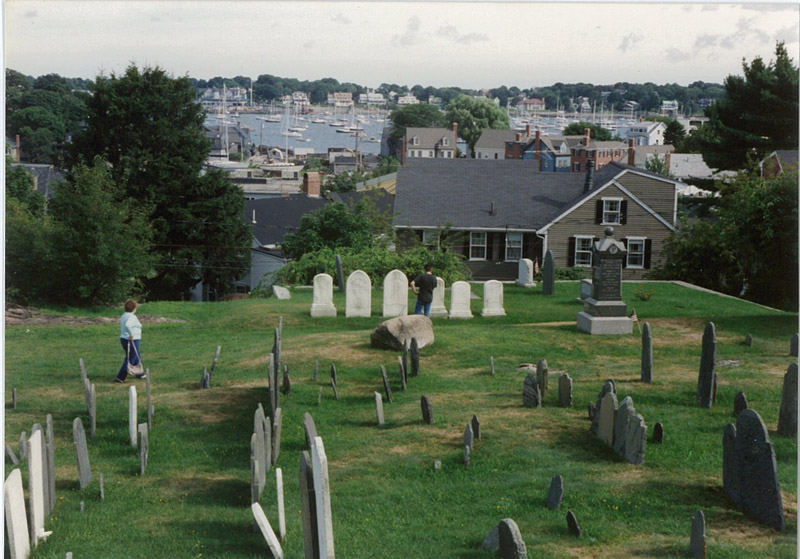
Old Burial Ground, Kingsport

Beside the road at its crest a still higher summit rose, bleak and wind-swept, and I saw that it was a burying-ground where black gravestones stuck ghoulishly through the snow like the decayed fingernails of a gigantic corpse. – The Festival

Kingsport-graveyard

Marblehead, Massachusetts, 1990

Though it pleased me, I would have relished it better if there had been footprints in the snow, and people in the streets, and a few windows without drawn curtains – The Festival

The photograph does not do justice to the  eerie subsidence in these New England graveyards, as though something was tunneling diligently beneath – but perhaps it is best if what this is remains something we must not and cannot recall.

And finally a last word from Lovecraft in a more reflective mood, writing of his beloved Providence:

I never can be tied to raw, new things,
For I first saw the light in an old town,
Where from my window huddled roofs sloped down
To a quaint harbour rich with visionings.
Streets with carved doorways where the sunset beams
Flooded old fanlights and small window-panes,
And Georgian steeples topped with gilded vanes –
These were the sights that shaped my childhood dreams.
– Background 

Leave a comment

Filed under Library Use, Travel

Visiting Lovecraft Country

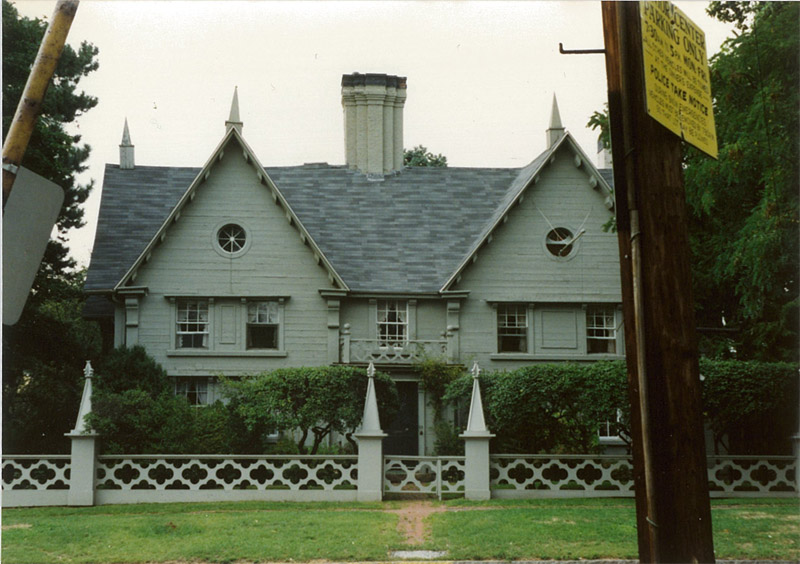
In 1990 Mark and I traveled to Rhode Island and Massachusetts for Lovecraft’s centennial. In company with the redoubtable Keith Herber and his friend Rick we visited Salem, Providence, and several of the towns that inspired Kingsport and Arkham. Keith was at that time writing his landmark series of books on Lovecraft Country for Chaosium and we could not have wished for a more engaging travel companion; when we return to New England next month for NecronomiCon Providence we will miss his sly smile and ready laugh.

One goal of our trip in 1990 was to try to rediscover Lovecraft Country by visiting each of the towns he had used as the basis of his famous fictional versions. When we stayed in a low-ceilinged Salem guesthouse which had been continuously inhabited for 300 years we were half expecting to see Brown Jenkin scamper across the counterpane.

Arkham cemetery

Arkham cemetery (Salem cemetery, Massachusetts, 1990)

Most of Lovecraft’s invented towns were based on two or three actual towns, frequently combing the geographic location of one with the architecture or atmosphere of another.

Arkham is generally based on Salem, however Salem is a sea port and Arkham is inland. Lovecraft probably originally based Arkham on New Salem, a town in the Swift river valley, which became the Miskatonic. The nearby town of Oakham most likely contributed to the fictional name.

Arkham

Arkham (Salem, Massachusetts 1990)

When proposals to dam the Swift river to create the Quabbin reservoir were proposed in the late 1920s, the ever-scrupulous Lovecraft felt forced to move his mythical town. Arkham became geographically identical to Salem.

The hamlet of Greenwich appears to be the inspiration for Dunwich, in terms of physical proximity to New Salem, although other, more rural towns were mentioned by Lovecraft as closer in spirit to its isolated “backwoods” atmosphere. Lovecraft, again for reasons of geographic accuracy, ceased to use Dunwich as a location once plans for the reservoir were mooted.

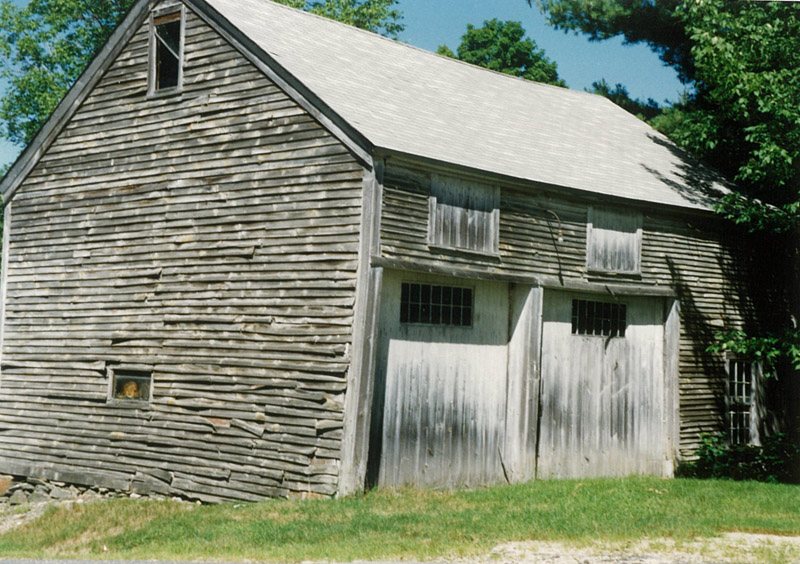
Dunwich

Dunwich (New England backwoods 1990)

The Quabbin reservoir was eventually created several years after Lovecraft’s death in 1937, and Greenwich was indeed razed and drowned. The reservoir features, unnamed, in ‘The Color Out of Space’, where nothing will make the narrator drink the new town water of Arkham.

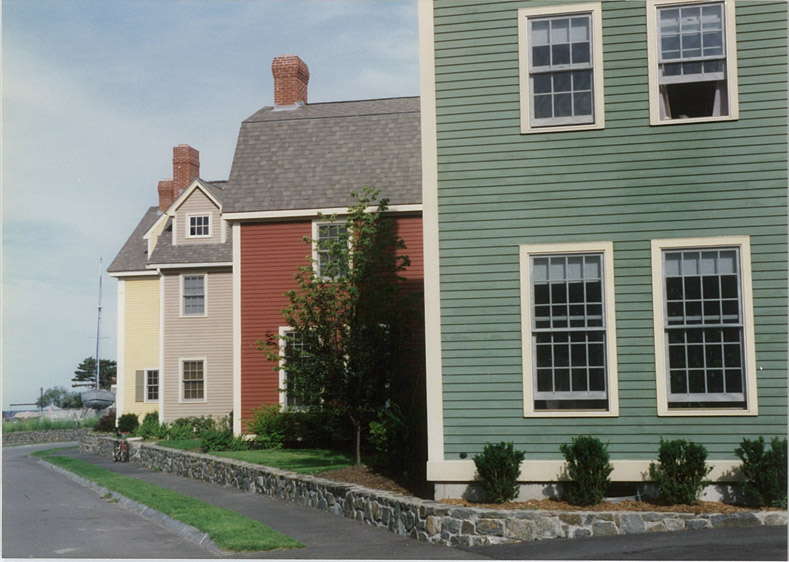
Kingsport is based on Marblehead and the nearby Rockport.

Kingsport-houses

Kingsport (Marblehead, 1990)

Innsmouth is inspired by Newburyport’s architecture, but geographically placed on the fishing village of Gloucester. Hence the narrator of ‘The Shadow Over Innsmouth’ gets on the bus at Newburyport and then travels to Innsmouth.

Innsmouth

Innsmouth (Newburyport, Massachusetts, 1990)

With thanks to the following eldritch tomes for refreshing my failing memory:

Eckhardt, Jason C. Off the Ancient Track: A Lovecraftian Guide to New England and Adjacent New York,  Necronomicon Press 1987

Cooke, Jon. B. (ed.) H.P. Lovecraft Centennial Guidebook: A Handbook of the Weekend of Events Celebration the 100th Birthday of a Great Horror Writer. ‘Lovecraft’s New England: The Haunted Backwaters of HPL’, Murray, W. Montilla Publications 1990

At the time I took some notes of the epitaphs on the tombstones in the Salem and Newburyport graveyards. The notebook in which I recorded them is long lost, but these days we have Wikipedia to fill in the blanks. It is fitting, for this post, that the last words belong to the dead:

Remember me as you pass by,
As you are now, so once was I,
As I am now, so you must be,
Prepare for death and follow me.

– Epitaph on a New England gravestone

6 Comments

Filed under Library Use, Travel

A Provençal Dragon

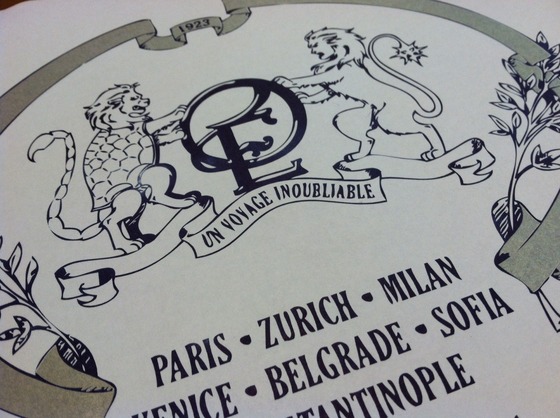
Horror on the Orient Express placemat [Source: Chaosium]

The Wagons-Lit logo is two rampart lions. For Horror on the Orient Express merchandise Chaosium under Meghan’s sterling art direction has created a new and unique logo, putting a fantastical spin on the traditional image and updated the two lions to a tarasque and a manticore.  The tarasque is a Provençal dragon and thus an authentic European monster.

According to my handy  Dictionary of Fabulous Beasts (Walker & Co. 1971) the tarasque lived on the banks of the Rhone near the town of Tarascon. It was “bigger than an ox…with a lion’s head and mouth; its jaws contained vast teeth, it had six bear’s paws, a carapace studied with spikes and a viper’s tail.”   The redoubtable St Martha, yet another Biblical figure who somehow found her way to Europe, tamed it by drenching it with holy water.

In case the description is not vivid enough a delightful Tarascon statue  gives a presumably authentic view of the monster, given that it is located near St Martha’s tomb. To my eye, it looks a little worried. We can assume that the statue depicts the moment after St Martha tamed it when the monster noticed the approach of the good townsfolk of Tarascon, who failed to trust in its wholehearted conversion and stoned it to death.

Tarasque statue [Source: Tarascon website]

This week we were briefly excited when the pelaton in the Tour de France sped through Tarascon, but try as we might we could not catch a glimpse of the tarasque.

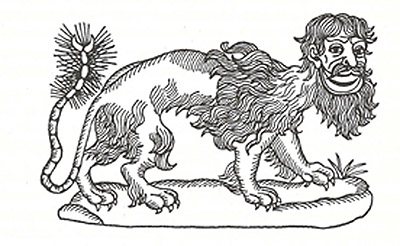
The manticore has an interesting lineage, born in Persia and making its way by rumor to Europe.  My Dictionary quotes Aristotle, quoting Ctesias (Alexander the Great’s personal physician, whose works are now lost): “the Indian wild beast called the ‘marticoras’ has a triple row of teeth in both upper and lower jaw; that it is as big as a lion and equally hairy, and that its feet resemble those of the lion; that it resembles man in its face and ears; that its eyes are blue, and its color vermilion; and has the faculty of shooting off arrow-wise the spines that are attached to its tail.” The same source notes that it can run as swiftly as a deer, no bad image for train. It is thought to born of garbled travelers’ tales of tigers.

Manticore [Source:

Manticore [Source: A Dictionary of Fabulous Beasts]

Leave a comment

Filed under Chaosium, Library Use, Travel

Train of the Dead

There was once a dedicated funeral train which traveled between London and the Brookwood Necropolis, Surrey. Brookwood was created in the 1850s. Its designers envisaged it as a garden ‘City of the Dead’ where London’s dead could rest in peace far from the overcrowded cemeteries of the city.

The train carriages were constructed and the branch line was laid out with all due consideration to Victorian notions of dignity and propriety.  The train carried mourners and coffined corpses. First, second and third class carriages were built for both the living and the dead, and nonconformists were carried in separate carriages to Anglicans. First class mourners and corpses paid a steeper price but their carriages were magnificently decorated. Conversely, one pictures poor corpses, like the recipient of this third class coffin ticket below, being laid out in something like a horse stall. 

Brookwood coffin ticket [Source: Wikipedia]

Brookwood was a cemetery built for profit, but the fares were fixed as a concession  for the poorer mourners and were never raised during the life of the train.  Sadly for the directors the Necropolis never received as many burials as the prospectus rosily prophesied. Towards the end of its life it seems that a fair percentage of its profits came from golfers, who disguised themselves as mourners in order to take advantage of the fixed fares to reach the nearby golf course.

The end of the line came, literally and figuratively, on the night of 16th November 1941, when one of the last raids of the Blitz destroyed the Necropolis station terminus at Waterloo. The station was never rebuilt, and the line closed.

The crest of the London Necropolis and National Mausoleum Company [Source: Wikipedia]

The  Latin motto translates as ‘a good life and a restful death’.

Brookwood Necropolis remains, overgrown and dismal. The rail lines and sleepers are long gone. A sad end to a good and useful train.

The Necropolis Railway does not feature in Horror on the Orient Express, but we wish it had. The idea of a train of the dead is irresistible to the thinking Keeper. Thanks to Dick, one of our fearless playtesters, for telling us about this extraordinary service.

5 Comments

Filed under Library Use, Travel

A New York Family in Venice 1923

In this charming home movie, a family catch a gondola ride in Venice while the the narrator, Naomi Bloom Rothschild, at  the ripe age of 89 years, gazes in wonder at her 3-year old self. In passing she speculates on the likely damp nature of the cellars in Venice. Clearly a native born New Yorker, it would be heresy to imagine a whole city without cellars.

The fashions are wonderful, and Venice has aged gracefully in the intervening decades. San Marco Square and the Rialto bridge look the same as they do today but with fewer tourists thronging the narrow ways.

We found it moving to look at the very canals and alleys where the investigators will run in such terror in our fictional visit to Venice.

Leave a comment

Filed under Library Use, Playtesting, Travel

Sacred Spaces, and Why They Scare Us

Once aboard the Horror on the Orient Express the intrepid investigators should seize the chance to explore the many  famous cathedrals en route.  Not only do these cathedrals husband thousands of years of history, but in several cities they hold valuable clues to the mystery at hand.  Besides, climbing the bell towers of Europe is one way to keep fit and allow the fleet of foot to outrace, if not the ravening Cthulhoid monstrosity, then at least their less fleet friends.

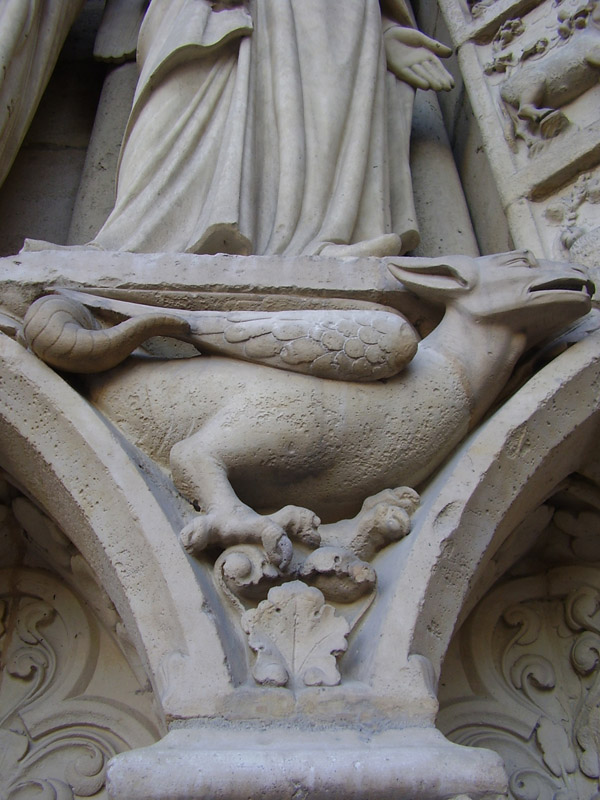
Notre Dame Dragon

Dragon carving from Notre Dame, Paris [Europe 2010]

Cathedrals are also vast and spooky spaces. They are deliberately built on an inhuman scale to impress the faithful with their insignificance in the sight of God. If the Cathedral is in any way wealthy it will be packed with tombs, statues, mosaics, alter screens and carvings, gargoyles and effigies,  crypts and relics,  all of which can be used by Keepers to instill a few harmless horrors in their players. It keeps them alert, gets the heart pumping, and does them no end of good.

Interior of Aya Sofia, Istanbul [Source: Europe 2010]

Interior of Aya Sofia, Istanbul [Europe 2010]

The Horror on the Orient Express takes place in winter, a time of early darkness, and general gloom. The shadows clustering in the nave, and thickening amid the vaults of the ceiling far overhead, may indeed be caused by the dwindling daylight, or  perhaps something more sinister.  Do the investigators wish to wait and find out? That flapping sound from the bell tower is probably just a flag blowing in the wind. Does some intrepid soul wish to climb up, and see for themselves?

Notre Dame interior [Source: Europe 2010]

Interior of Notre Dame, Paris [Europe 2010]

The writer par excellence who evoked the horror of the sacred space was M.R. James. A Cambridge don, he wrote a mere thirty ghost stories. He is the writer to read if you seek an imp in a Cathedral close,  a demon guarding an Abbot’s treasure  or a devil-haunted vicarage. The antithesis of Lovecraft, M.R. James wrote in spare, erudite prose. His ghosts are glimpsed only in snatches, generally as his terrified narrator is running for their life and sanity. His haunts are utterly malevolent. Sometimes they hunt a murderer, or avenge a theft. More often their vindictiveness is attracted  by accident. The hapless hero of  ‘Oh Whistle and I’ll Come to You my Lad’ simply blows an old whistle and is hunted by a terrible figure “with an intensely horrible face of crumpled linen”, while the luckless protagonist of ‘The Diary of Mr Poynter’ draws supernatural ire merely by making a very unfortunate choice in wall-paper.

“Oh Whistle and I’ll Come to You, My Lad” [Source: Dream Quest magazine, G.W. Thomas]

The stories of M.R. James are very adaptable to Call of Cthulhu scenarios set in England and the Continent, featuring as they do a cast of bookish dons and antiquarian  scholars. The only problem in plotting these stories as scenarios lies in their inscrutable malevolence. There is often simply no way to fend off the haunt. In other words, no way to save the haunted.

3 Comments

Filed under Travel, Writing

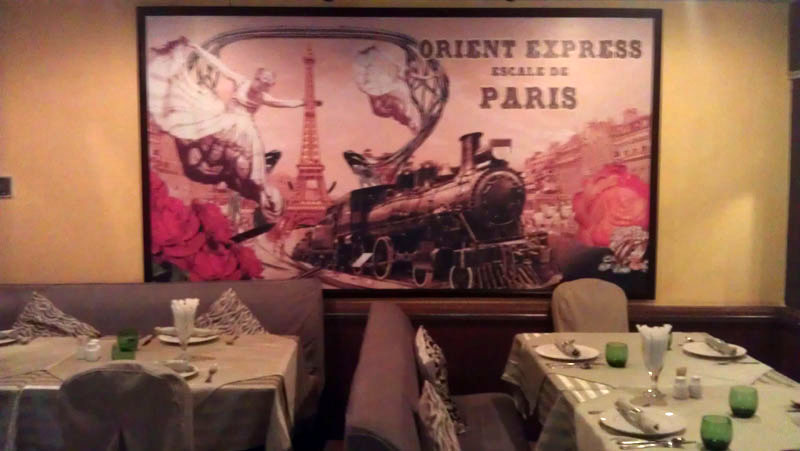
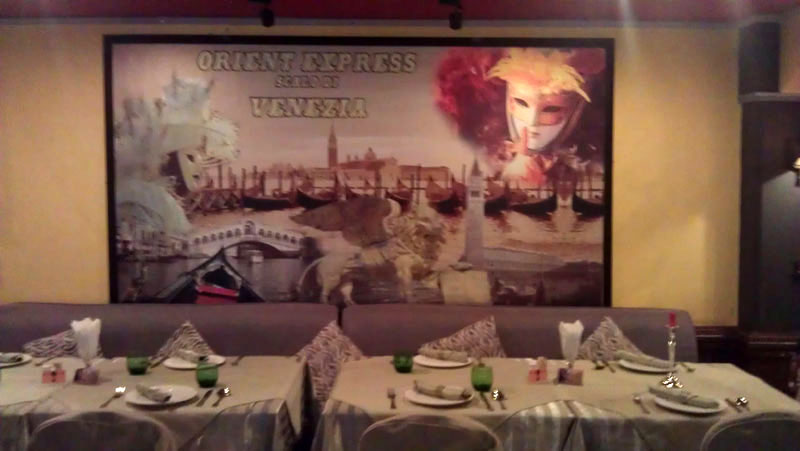
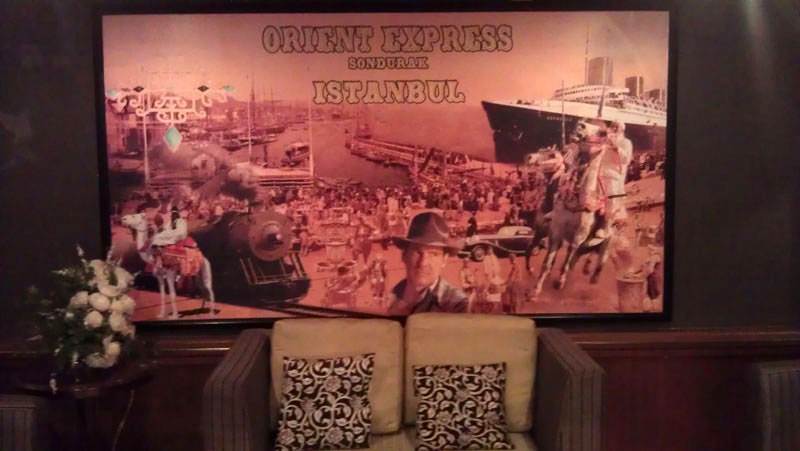
Orient Express, Guangzhou

A menu to remember

This train arrives in the most unexpected destinations.

Christian is one of our playtesters, but he is currently away for a month while travelling in Hong Kong and China. He just emailed us: “While missing the games back in Melb, I’m currently eating in the ‘Orient Express’ in Guangzhou!”

What did he eat? “It’s French cuisine – owner is a French guy. It’s located in the old French concession on Shamian island as Guangzhou used to be quite colonised like Shanghai.”

The Orient Express: wherever you go, there it is.

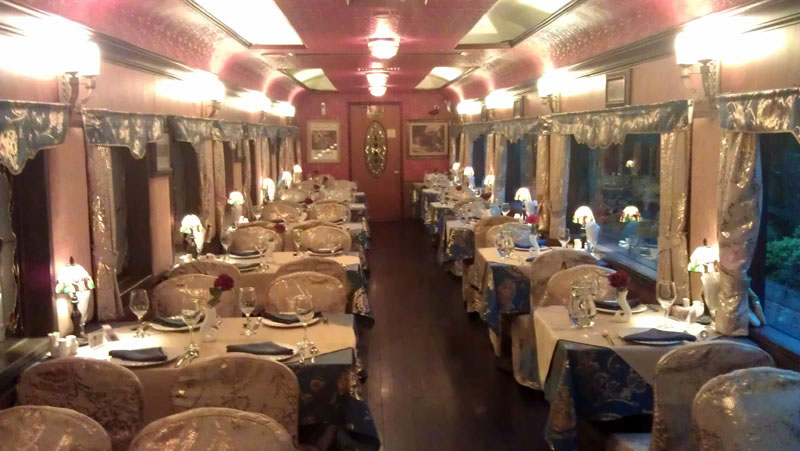
The dining car

The dining car

Paris via Guangzhou

Paris via Guangzhou

Venice via Guangzhou

Venice via Guangzhou

Istanbul via Guangzhou

Istanbul via Guangzhou

Leave a comment

Filed under Travel

Revisiting Venice I – The City

So Mark’s play-testers have survived Venice, and are on to Trieste. As one player astutely observed, the real hero of the scenario was Venice herself.

I’ve re-visited Venice both in metaphor and in reality. I hadn’t been to the city when I wrote the scenario twenty odd-years ago. I had read John Julius Norwich’s A History of Venice, and I had always vowed to visit before I was thirty. I managed it, just.

Before I left my mother gave me a wonderful gift, picked up in a second hand bookshop, E.V. Lucas’s A Wanderer in Venice. E.V. Lucas wrote his guidebook to Venice in 1914. Aside from the Austrians no longer sunbathing  on the sands of the Lido, his lively tome is still an excellent guide. I could retrace his steps, see what he had seen, and count the winged lions along the canals at his side.

Lucas and Norwich generously gave me their Venice and their views still colour mine today. It was a city born of the printed word and pictured firmly in my imagination before I ever saw it in reality. And unlike most visions born in this way Venice was even more beautiful than I imagined.

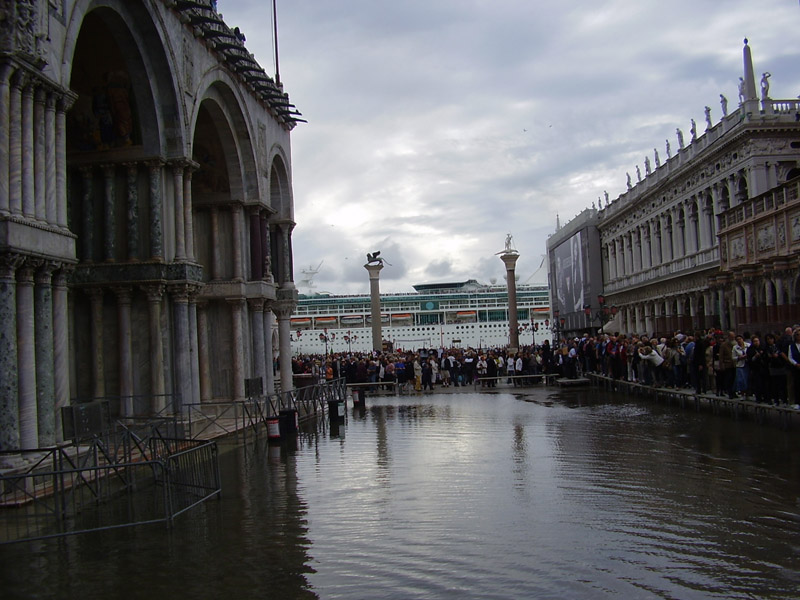
Sixteen years later I re-visited Venice, this time with Mark. Venice is slowly sinking into its marsh. It had sunk several more centimetres by then, so at high tide St Mark’s Square was awash and the sea crept into the entry of the basilica.

St Marks at High Tide

St Marks at high tide

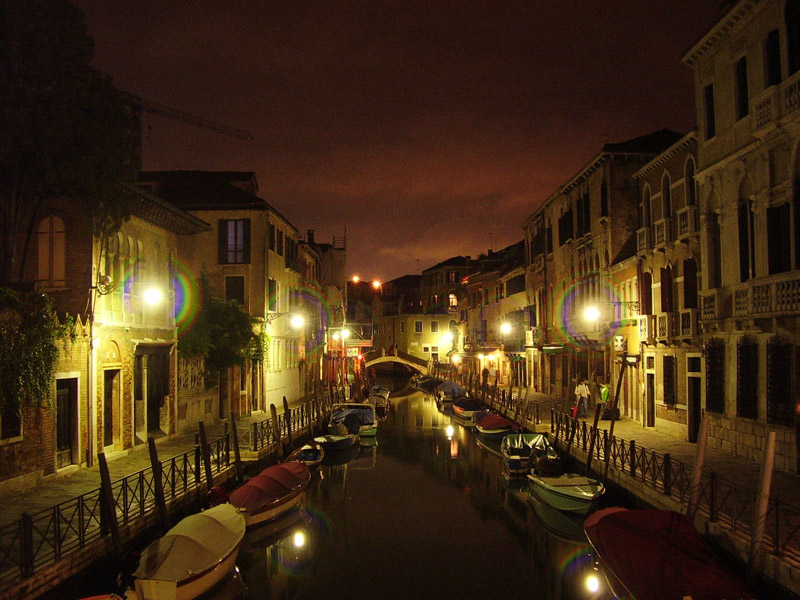
The city seemed to be losing the fight against two equally remorseless foes: salt water and tourists (of which I was one). Its beauty was all the more heartbreaking. The atmosphere of this city is unique. At night all is quiet and dark, with only the lights reflecting on the canal water.

Venice canal at night

Venice at night

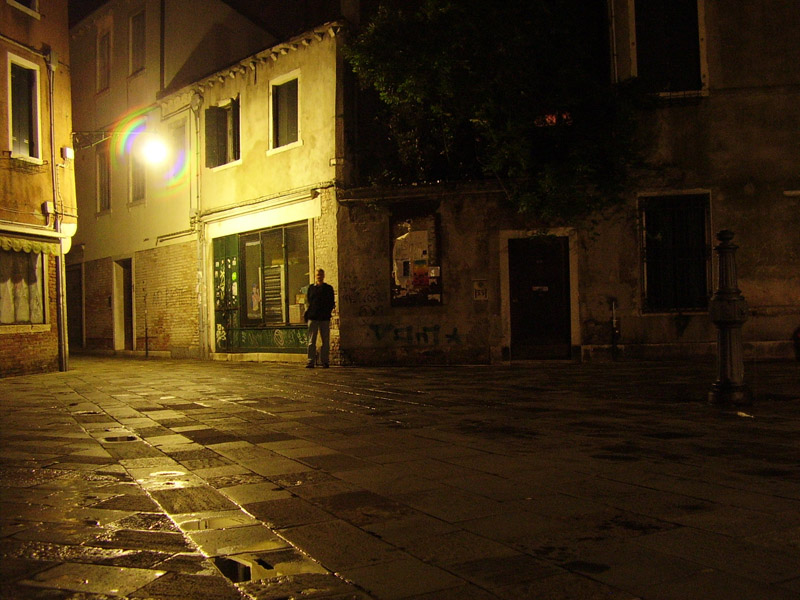
Mark in Venice at night

Who is that figure lurking in the Venetian darkness? Oh, it is only Mark.

Leave a comment

Filed under Travel

Sirkeci Station

So you may have been wondering about our header photo. It is Sirkeci station, the grand terminus of the Orient Express. This photo is from a trip that Mark and I took along the train route in 2010 from London to Istanbul to celebrate the 20th anniversary of our writing about the train.

Istanbul's Sirkeci station 2010

Istanbul’s Sirkeci station 2010

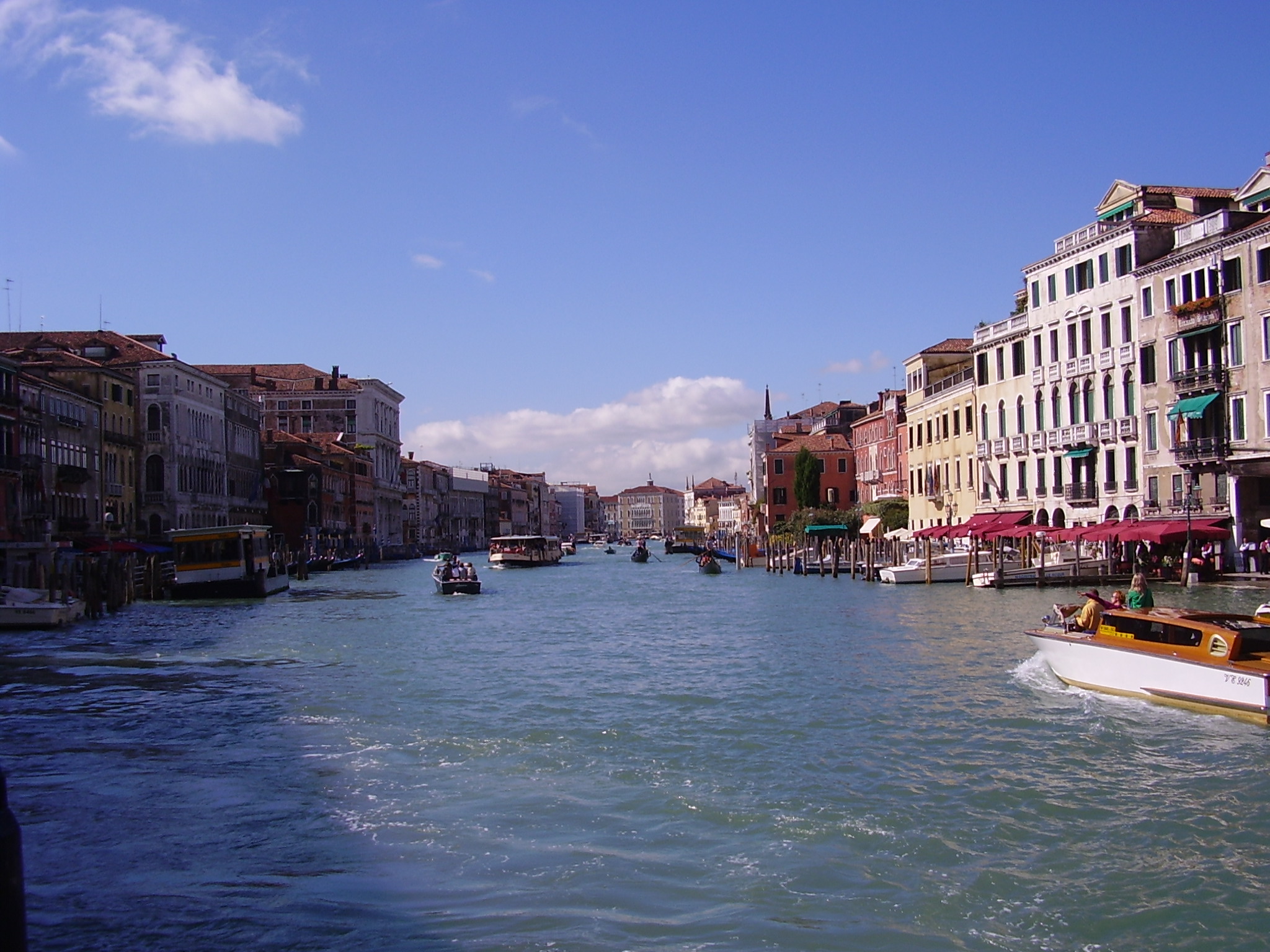
Let’s face it, most big city train stations are approached through industrial estates. Sirkeci has to be one of the best situated stations in the world. To my mind its only rival is Venice’s Santa Lucia, where the unsuspecting first-time visitor walks out of the terminal to find the sea lapping at the edge of the station piazza. The sea! Will you look at that? Okay, it’s actually the Grand Canal, but it still smells pretty salty and really cements the impression of Venice as a city built on water. I think Istanbul and Venice are two cities that are best approached by train.

Venice Grand Canal 2010

Venice Grand Canal 2010

The Istanbul train enters the city along the shore of the Sea of Marmosa. The tracks pass Istanbul’s land walls – never breached, ladies and gentlemen, if you don’t mind a short history lesson – and still mammoth in ruin.

Istanbul Land Walls 2010

Istanbul Land Walls 2010

Then the train passes around the Golden Horn along the Bosporus, passing a jaw-dropping  array of beautiful buildings, the Topkapi Palace, the Blue Mosque and the Aya Sofia. Istanbul’s apartment buildings pile up over the surrounding hills. It is a breath-taking entrance, even when bleary-eyed in the morning after a day and a night on a ramshackle yet lovable old train, including standing in line after midnight for an entry visa at the Turkish border.

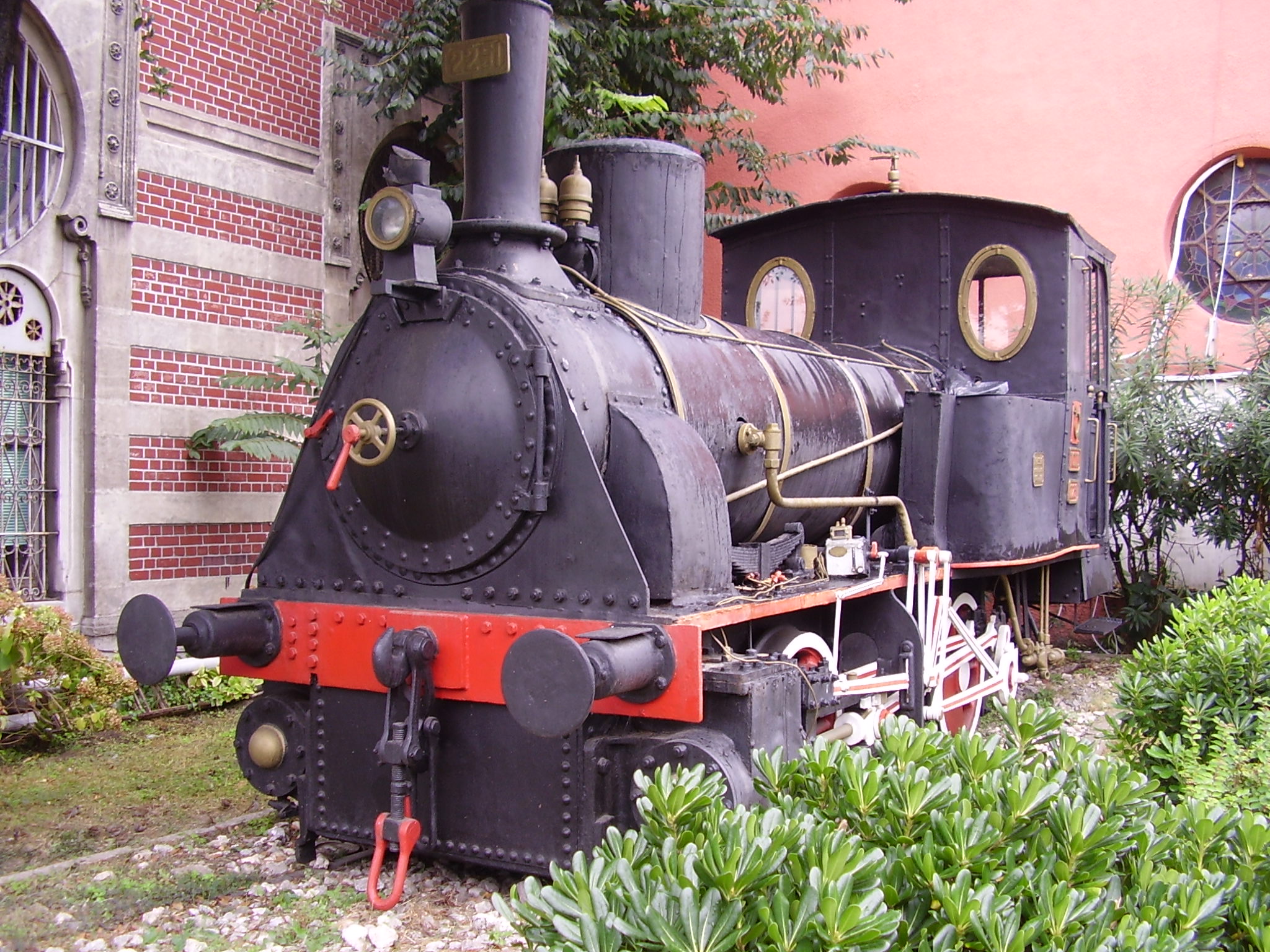
Sirkeci station was built in the 1880s and according to the guidebook is one of the most famous examples of the European Orientalism school of architecture. Apparently is also holds a train museum, which Nick and Meghan visited on their research trip but we somehow missed. Instead, we found this oddly pathetic train, stalled out front the station forever, but never investigated further.

This train is not going anywhere

This train is not going anywhere

From Sirkeci station, if you turn right you cross the Galata Bridge to the Pera Palace hotel, beloved of the wealthy Orient Express passengers. If you turn left you’re in the heart of the Sultanahmet district. There you’ll find yourself slapped down in the middle of all that gobsmacking architecture you glimpsed from the train; the Blue Mosque, the Archaeological Museum, the Aya Sofia and the Topkapi Palace. If you keep going, assuming you can walk past the Basilica Cistern (and who’s going to resist going down to peek at an ancient  spooky columned cistern full of dark water and giant carp) you will trip over the Serpent Column and run smack into the last standing wall of the Hippodrome. Seldom has one train station offered entrance to so much.

Sirkeci station is at the heart of all of the scenarios in the new Horror on the Orient Express; the investigators will arrive or depart from the station in the Gaslight, 1920s and modern eras. There are some evocative departure scenes in the classic 1974 and superior 2010 versions of Murder on the Orient Express. Alas, we flew home to Australia from the charmless airport instead.

1 Comment

Filed under Travel