Looking at real places is always a help when running a scenario. The Guardian website has a feature on opening night at La Scala, Milan. It’s a vivid and heartfelt look behind the scenes at La Scala, and really sums up the central place the opera house holds in the hearts of the opera-l0ving Milanese. It will also give Keepers some ideas on how to run the Milan chapter of Horror on the Orient Express.
Author Archives: Penelope Love
The Dreamlands Express II – The Bestiary of Dreams
When I was compiling the Dreamlands Express itinerary I thought about the fauna and flora of the Dreamlands and added it to the views from the train by way of local colour.
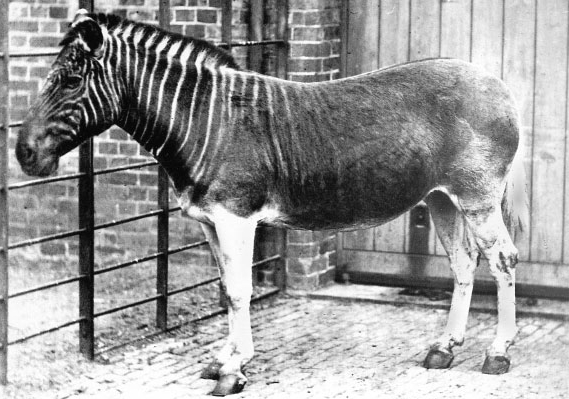
The fauna included Dreamlands fauna like magah birds, at least one animal of my own invention (from a dream in fact), and a smattering of real animals, mainly African. After all there are elephants and peacocks, yaks and zebras in the Dreamlands, so there must be a few other exotics tucked away. This had an unexpected side-effect. Just before Mark play-tested the Dreamlands Express scenario I found him leafing through the Dreamlands bestiary looking for quagga and okapi. I hadn’t realized it was possible to mistake these real world animals for dream beasts, but I guess their names do look kind of made up.
The okapi, a pleasingly defined “giraffid artiodactyl mammal”, is fortunately still with us:

What this okapi photograph doesn’t show you is that okapi tongues are so long they can lick their own eyeballs [Source: themagazine.ca August 2009]
A South African sub-species of zebra, it was hunted to extinction in the wild. The last quagga died in an Amsterdam zoo in 1883. I included the quagga in the Sona-Nyl description because one of the few things we now know about the quagga – the sound of its cry – was described in a poem. As Robert Silverberg notes dryly in The Dodo, The Auk and the Oryx, it is not a good poem, but it gives us today this one useful fact. I thought that any animal immortalized in poetry should have a chance to live on in Sona-Nyl, the Land of Fancy.
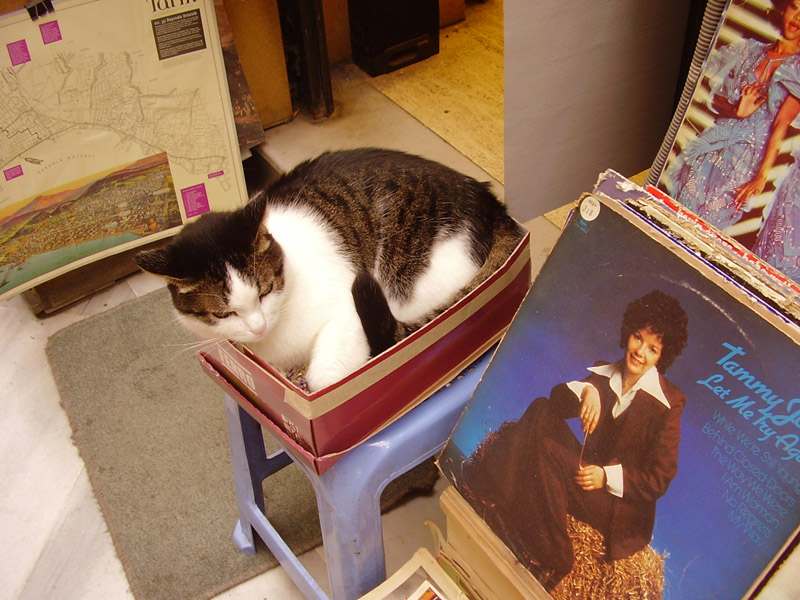
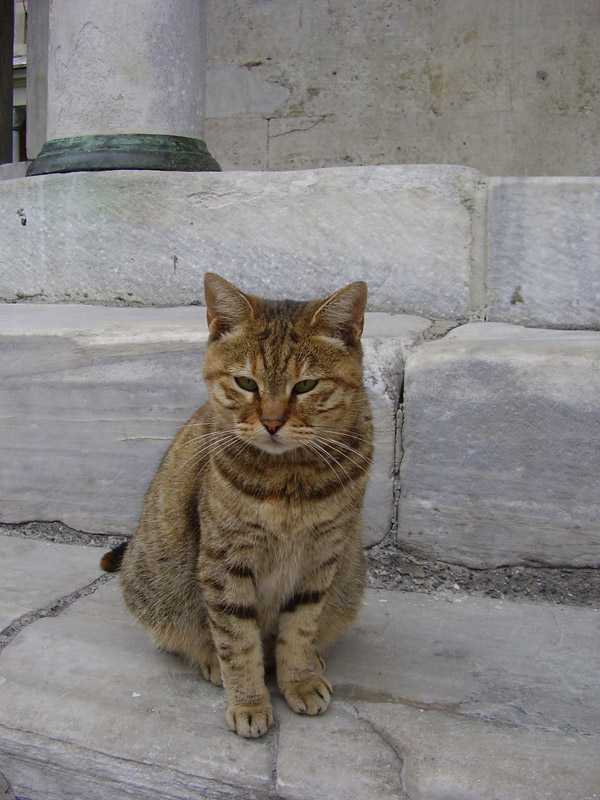
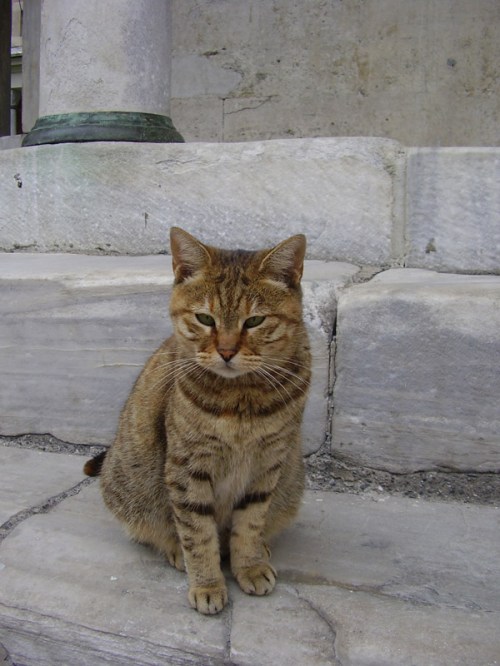
The other important Dreamlands animal is of course the cat. Lovecraft loved cats and the Dreamlands was one of the few areas of his fancy where he could give this affection full play. I had great fun with a cat sub-plot on the Dreamlands Express, where cats have their own compartment and are treated as full passengers. If the dreamers ask about this, they are given reasons taken straight from Lovecraft’s DreamQuest and The Cats of Ulthar: For the cat is cryptic and close to strange things that men cannot see; for the Sphinx is his cousin and he speaks her language; but he is more ancient than the Sphinx and remembers that which she hath forgotten.So in closing, here are some cats of Istanbul. Remember, they are looking out for you in their dreams.
Filed under Writing
The Dreamlands Express I: The Geography of Dreams
Warning: Here be spoilers…
I cannot live up to the enchantment of Christian’s previous post about Poissy but this post is also concerned with coincidence and other odd ways in which a writer’s mind works.
A fragment found folded between the seat and the wall on the Orient Express:
Last night in my compartment of the Orient Express I dreamed of a train so marvelous that in the morning my pillow was wet with tears of joy. It was no creation of iron and steam but of airy palaces borne aloft on the backs of vast beasts. Yet when I woke my heart was sore, for someone on this marvelous train did kill a cat, and in that land this of all things was forbidden.
So somehow a Dreamlands Express has shunted itself onto the back of the Orient Express, no mean feat for a dream world where technology has to be ‘fixed’ for at least 500 years in the waking world before it can exist.
This Express was born out of a discussion with Mark about a key issue with the plot of the Horror on the Orient Express. One particular enemy is simply too strong and can reduce unprepared parties to “one insane investigator, a 12-year old, and an NPC whose player has left to go to College”. Don’t laugh. That’s a near-direct quote.
Was there a way to provide a weapon against this enemy for weaker parties while allowing stronger parties to tackle it on their own? That was how the Dreamlands Express evolved, first with a fragment of an idea for the weapon, then an idea for a murder, then an idea for a mystery. Finally the train itself lumbered into view.
I don’t want to talk further about the scenario. I do want to talk about itineraries though. I compiled the train’s route using the descriptions from an old copy of the H.P. Lovecraft’s Dreamlands supplement and the haunting visions of Lovecraft’s stories. We then had to make some pretty strange decisions about some of these dream cities.
The city of Aira, for instance. It was the dream of the shepherd boy Iranon, in H.P. Lovecraft’s The Quest of Iranon. It was listed in both the text and the map of the early editions of H.P. Lovecraft’s Dreamlands, but has vanished from the latest edition (something we did not actually know until informed by Steff Worthington, resolute map artist). Did Aira actually ever exist, and if it did exist could it be visited?
The city of Zar in country of Zak posed a textual problem: was it the city of Zar in the Country of Zak, or the City of Zak in the country of Zar. Or was it just Zar. Or Zak. Lovecraft is no help as he contents himself with obscure hints; “no dreamer should set foot upon the sloping meadows of Zar, for it is told that he who treads them may nevermore return to his native shore.”
Finally, who or what is the eidolon Lathi that rules over the city of Thalarion? A definition I found spoke of Helen of Troy’s starring role in the Illiad, when ancient historians of Classical Greek world agreed that Helen was never in the city during the Trojan war. By placing her there Homer created an eidolon, a ghost of a woman who never existed in that time or place. How does that help us evoke Thalarion, whose ‘streets are white with the unburied bones of those that have looked upon the eidolon Lathi’? If they’re unlucky, your investigators will find out…
Filed under Writing
St Valentine’s Train
The Lovecraftian canon does not look kindly upon Romance. Few characters have any kind of love life, and female characters such as Lavinia Whately in The Dunwich Horror and Asenath Waite in The Thing on the Doorstep meet horrible ends – although it can be argued that Asenath was not, mentally speaking, female. The case for Romance is slightly more cheering when we turn to the monstrous. The white ape-queen of Arthur Jermyn and the Deep One princess of The Shadow over Innsmouth both get their man and survive to return home.
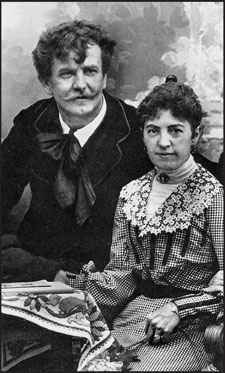
This lack could be because the knowledge of the insignificance of humankind in the face of cosmic horror blunts the romantic impulse, or it could proceed from Lovecraft’s life experience. Sonia Greene loved her man and admired his vision but she could not get work in Providence and he could not live in New York. The marriage lasted two years.
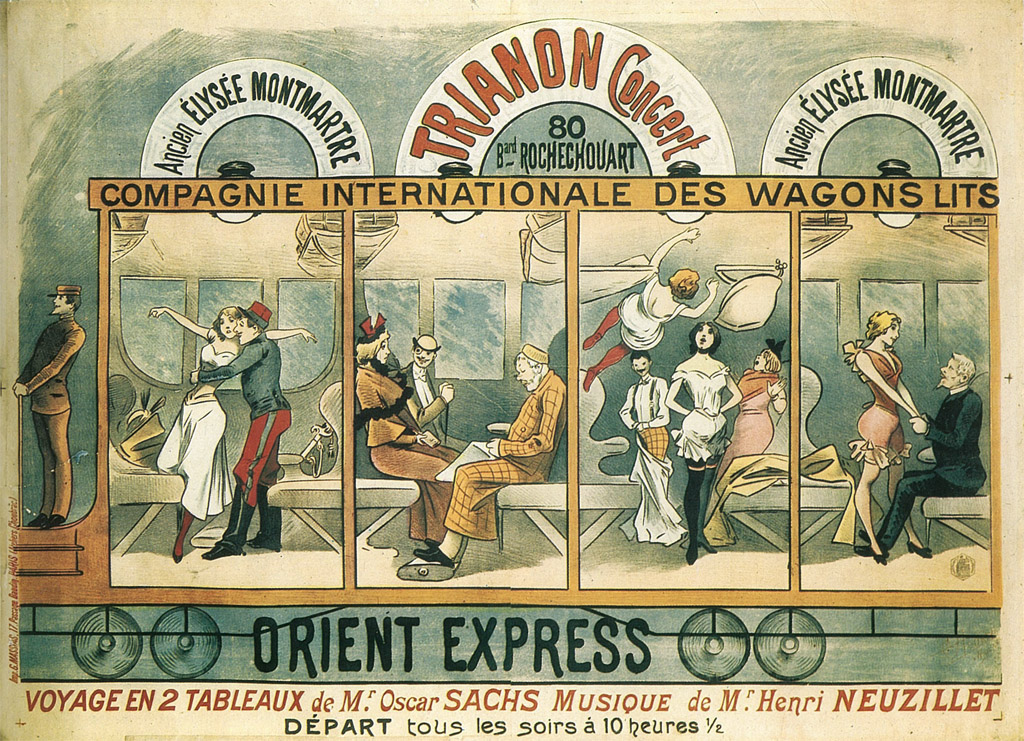
Fortunately Romance blossoms when we turn to the Orient Express. The mere idea of sleeping compartments , of strangers of the opposite sex reposing in close proximity, provided much delighted scandal in the staid Victorian Age. Colonel Mann was an early partner of Orient Express visionary, George Nagelmackers. Mann had a less than respectable private life, but this did not stop him attacking the rival Pullman carriages on moral grounds. The Pullman carriages had an open interior rather than enclosed compartments. Mann profitably harped on the immorality of being in mixed company when in night attire. As E.H. Cookridge notes dryly in Orient Express, ‘No one seems to have studied the interior layout of Mann’s boudoir cars with sufficient attention to realize that his private cubicles for two persons were infinitely more improper…’.
The popular view of the Orient Express as a hotbed of romance and scandal is vividly expressed in the image above, a poster for a nineteenth century French farce. We suspect that the clergyman in the compartment on the far right is dallying with a lady who might not be his wife.
In Horror on the Orient Express we have allowed for some love amid the madness. Christian and Veronique Lorien are the epitome of a committed and loving couple. The star-crossed lovers in Venice may yet prevail with investigator assistance. The divine soprano Caterina Cavorollo sings in the salon car of the Orient Express, in a pure expression of love that speaks to the soul of all who hear her, even cloth-eared investigators who would rather face the Black Goat of the Woods than listen to opera.
Romance endures, sometimes for a price. For $3200 AUD per person, a couple can travel from Paris to Venice on today’s loving re-creation of the Simplon-Orient Express. The overnight journey is a romantic gesture par excellence. Mark and I could not afford that on our 2010 trip. We booked on the regular service but we didn’t get on that either. There was a strike and the train was cancelled. We had an exceedingly unromantic overnight bus trip to Milan instead. The Orient Express branded carpet at St Lucia station in Venice was as close as we got.
Filed under Library Use
Library Use made easy
While Mark was running the Milan playtest the players got really interested in a mural in La Galleria Vittorio Emanuele. The Egyptian style mural was one of four in the roof of the Galleria, visible from their hotel room in the Hotel de la Ville (situated in the Galleria itself).
The mural’s Egyptian theme intrigued the players who had tickets to see Aida at La Scala. They spent some time trying to get a closer view. However there’s no closer view to be got without climbing the sheer stone façade of the Galleria. There’s a black and white illustration in the 1991 boxed set but showing a colour photograph to the players gives the image that much more impact.
Mark found some wonderful photos on Absolutely Faaabulous, a fashionista blog (of course; this is Milan after all):
The same blog also passed on a delightful rumour about the mysterious properties of a mosaic of a bull in the floor of the Galleria. If you spin three times on one foot on the bull’s testicles, your wish will come true. This is not quite as romantic as singing along with the singer on the stage of La Scala but has certainly had a deleterious effect on the bull’s testicles.
The Galleria Vittorio Emanuele handily connects La Scala Opera House to the Duomo Cathedral, these three beautiful buildings forming the heart of Milan.
On another Google Images related note, why describe the luxurious hotel to your investigators when you can show them a picture? In writing the Travelers’ Guide I am listing some truly opulent hotels in all of the cities (with some mid-price options for the less spend-thrift investigators). Some of these hotels are still in operation and their websites often provide historical images. Here’s one for the Beau-Rivage Palace, Lausanne (Source: hotel official website):

When you’re trying to describe a luxury hotel a picture certainly works wonders. The players invariably gasp and head for the cheaper option.
This has all been a lot easier than it was the first time around in 1991. It is a great age to be running Cthulhu scenarios, where you can have arresting images delivered to the tabletop via tablet or laptop.
Filed under Library Use, Playtesting
Ticket to Horror
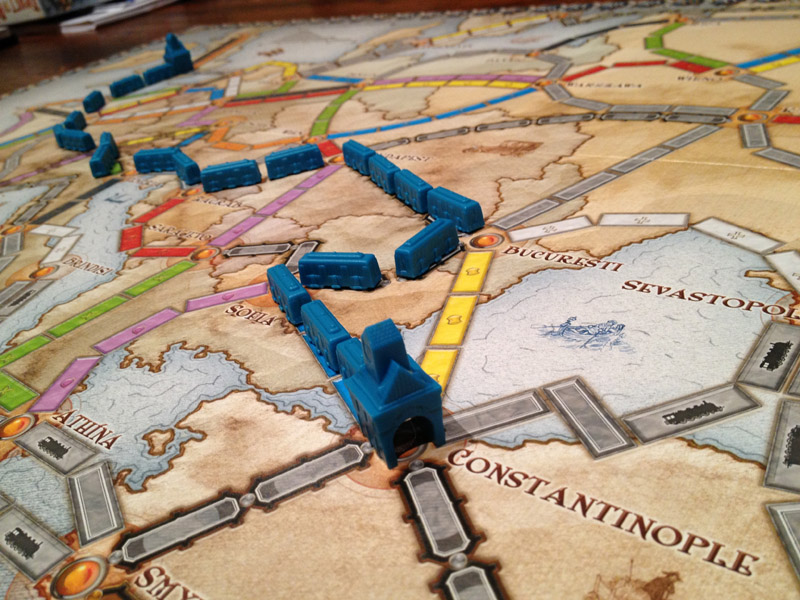
So for some reason Mark and I have been playing a lot of Ticket to Ride Europe.
Sirkeci Station
So you may have been wondering about our header photo. It is Sirkeci station, the grand terminus of the Orient Express. This photo is from a trip that Mark and I took along the train route in 2010 from London to Istanbul to celebrate the 20th anniversary of our writing about the train.
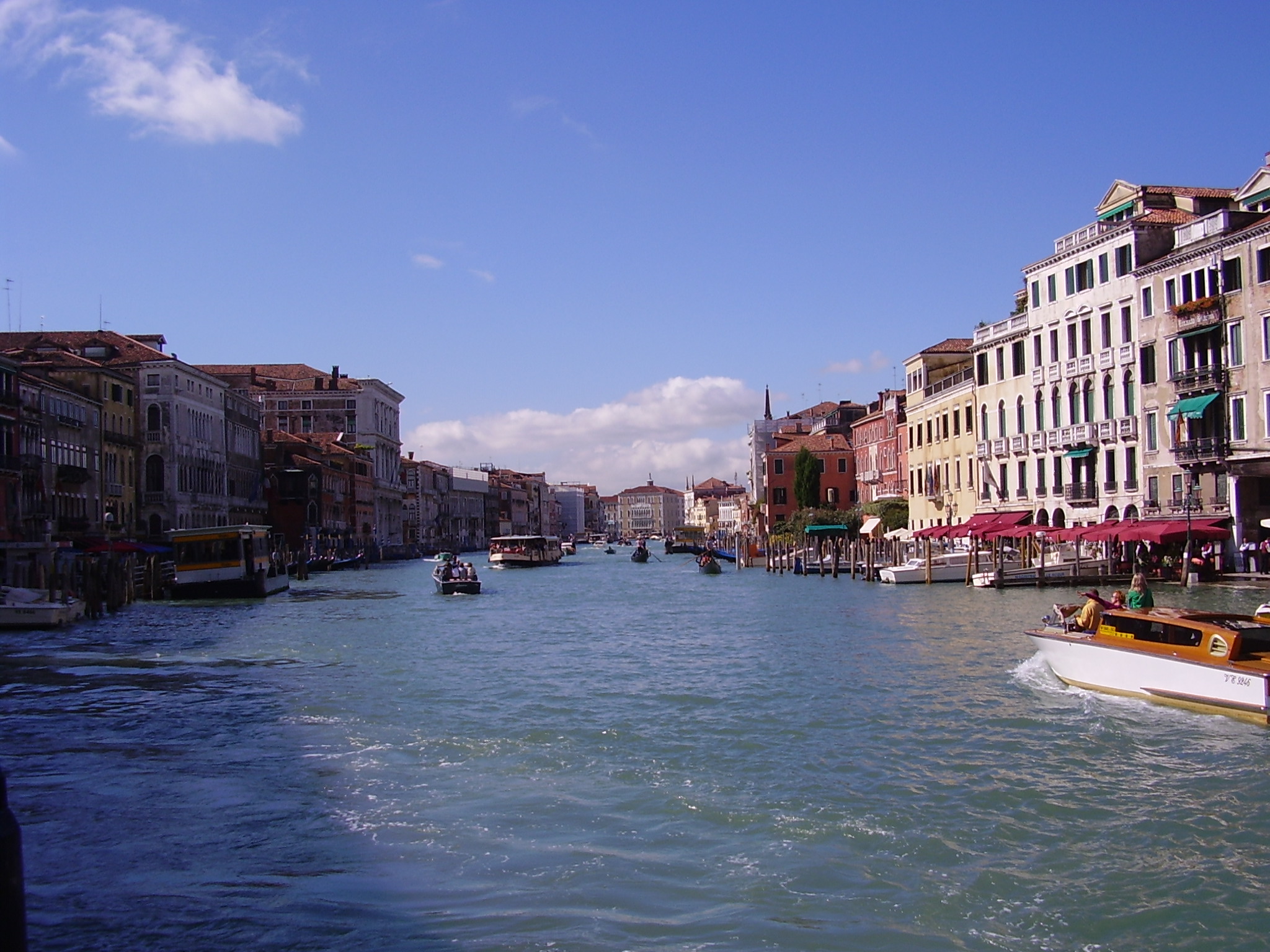
Let’s face it, most big city train stations are approached through industrial estates. Sirkeci has to be one of the best situated stations in the world. To my mind its only rival is Venice’s Santa Lucia, where the unsuspecting first-time visitor walks out of the terminal to find the sea lapping at the edge of the station piazza. The sea! Will you look at that? Okay, it’s actually the Grand Canal, but it still smells pretty salty and really cements the impression of Venice as a city built on water. I think Istanbul and Venice are two cities that are best approached by train.
The Istanbul train enters the city along the shore of the Sea of Marmosa. The tracks pass Istanbul’s land walls – never breached, ladies and gentlemen, if you don’t mind a short history lesson – and still mammoth in ruin.
Then the train passes around the Golden Horn along the Bosporus, passing a jaw-dropping array of beautiful buildings, the Topkapi Palace, the Blue Mosque and the Aya Sofia. Istanbul’s apartment buildings pile up over the surrounding hills. It is a breath-taking entrance, even when bleary-eyed in the morning after a day and a night on a ramshackle yet lovable old train, including standing in line after midnight for an entry visa at the Turkish border.
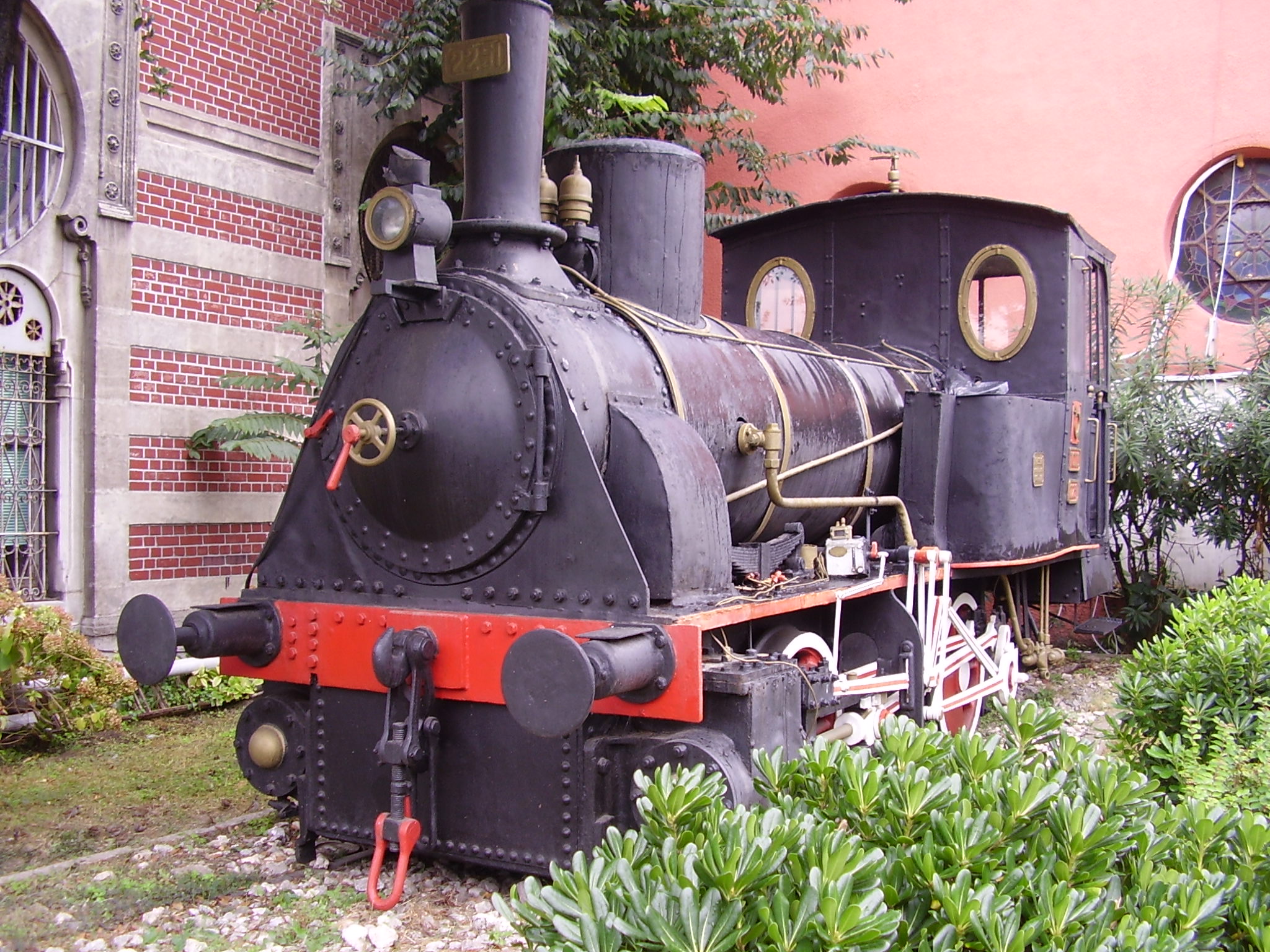
Sirkeci station was built in the 1880s and according to the guidebook is one of the most famous examples of the European Orientalism school of architecture. Apparently is also holds a train museum, which Nick and Meghan visited on their research trip but we somehow missed. Instead, we found this oddly pathetic train, stalled out front the station forever, but never investigated further.
From Sirkeci station, if you turn right you cross the Galata Bridge to the Pera Palace hotel, beloved of the wealthy Orient Express passengers. If you turn left you’re in the heart of the Sultanahmet district. There you’ll find yourself slapped down in the middle of all that gobsmacking architecture you glimpsed from the train; the Blue Mosque, the Archaeological Museum, the Aya Sofia and the Topkapi Palace. If you keep going, assuming you can walk past the Basilica Cistern (and who’s going to resist going down to peek at an ancient spooky columned cistern full of dark water and giant carp) you will trip over the Serpent Column and run smack into the last standing wall of the Hippodrome. Seldom has one train station offered entrance to so much.
Sirkeci station is at the heart of all of the scenarios in the new Horror on the Orient Express; the investigators will arrive or depart from the station in the Gaslight, 1920s and modern eras. There are some evocative departure scenes in the classic 1974 and superior 2010 versions of Murder on the Orient Express. Alas, we flew home to Australia from the charmless airport instead.
The Dream Cities of Istanbul and Providence
A seat is now empty, but the train moves on. Let us follow Randolph Carter, and journey in search of cities lost in time and dreams.
As part of my research for the Traveler’s Companion, I’m reading Orhan Pamuk’s Istanbul: Memories and the City. This isn’t the place to talk about Pamuk’s stature as a writer. It is Pamuk’s Istanbul that I am concerned with here, the city of his childhood in the 1950 and 60s, and how this can be related back to a Lovecraftian experience of Istanbul in the 1920s.
Pamuk evokes a city of winter, of darkness, of shadow, of twilight, of gloom and poverty. He lingers lovingly over every detail of the slow ruin of the grand old mansions lining the Bosporus. Pamuk’s city is permeated with an aching consciousness of loss, huzun, a Turkish word he re-interprets as a communal melancholy suffered by Istanbul residents, arising from a deep awareness of their city’s fall from greatness.
Lovecraft’s twilight city, his dream Providence, is a fleeting glimpse filled with ‘the poignancy and suspense of almost-vanished memory, the pain of lost things, and the maddening need to place again what had once had an awesome and momentous place.’
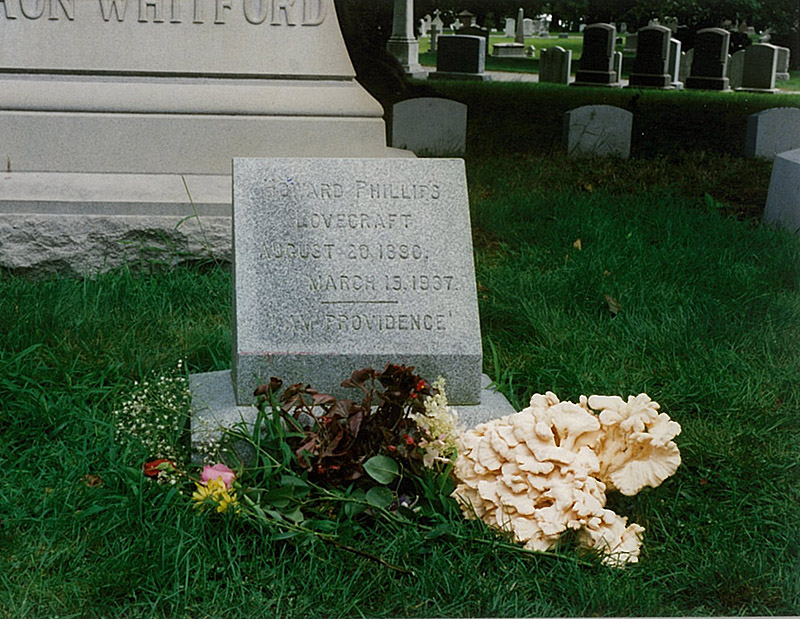
These are two very different writers confronting the same vision, and both writers assert the primacy of their dream city over the reality, to the point where reality shadows the dream. At the time of writing Istanbul, Pamuk had never left the city, and indeed had returned to live in the same apartment building that he lived in as a child. He felt the city fed his imagination and he would lose too much if he left. Lovecraft stayed in Providence and on College Hill, apart from a short unhappy stint in New York. He could not abandon the city that stood at the center of his craft. His tombstone reads, simply, ‘I am Providence.’
Pamuk also collected newspaper columnist jottings, some of which he shares in a chapter of Istanbul. Here is an admonition from our period, 1929, a final word on lost places and lost times:
“Like all the clocks that adorn our city’s public spaces, the two great clocks on either side of the bridge at Karaköy don’t tell the time so much as guess it; by suggesting that a ferry still tied to the pier has long since departed, and at other times suggesting that a long-departed ferry is still tied to the pier; they torture the residents of Istanbul with hope.”

H.P. Lovecraft’s grave with the dedication “I am Providence”. Photo taken on HPL’s 100th birthday; note the brain-shaped fungus, lovingly laid. (Providence, 1990)
Filed under Writing
Omelette aux Truffes
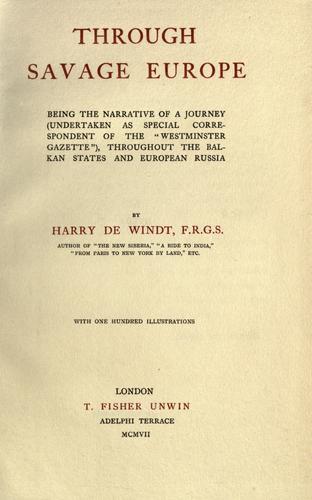
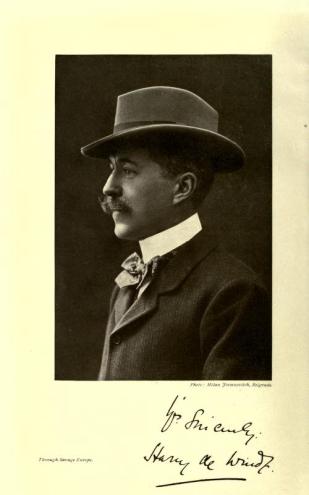
I am currently working on the Traveler’s Companion, a booklet for players. 1920s tourist information for the Balkans has proven difficult to come by in English, especially with my 25% Library Use. The area was beyond the itinerary of all but the most ambitious Western European travelers and Baedekers shed no light for me. I trawled through some earlier material indexed at archive.org and found Through Savage Europe, the adventures of Harry De Windt, the intrepid correspondent for the Westminster Gazette and his trusty “bioscope artist”, the redoubtable Mr Mackenzie. Although published in 1907, well before our 1920s setting, this little volume gave me a lovely vignette of the Orient Express, as our weary and paprika-stained travelers climb aboard just outside of Sofia. It evokes the train as a rolling Shangri-La and perfectly captures the wonder contemporary travelers felt towards the Express.

Filed under Library Use
The trailer we wish we’d made
In starting our research we looked up YouTube to see what Orient Express footage was available. Lo and behold we found quite a few trailers for Horror on the Orient Express. This one by MalleusCalixis uses borrowed music and footage and some great archival photos to perfectly sum up the mood of the campaign, so much so that Mark used it to open the first evening of playtesting. The players spontaneously applauded.
We loved the fact that this campaign that we published years ago has caused so many creative echoes and ripples. Thanks Malleus!
So turn down the lights, turn up the sound, and enjoy.
Filed under Playtesting