Tag Archives: Call of Cthulhu

Tree Hugging in Constantinople

Constantinople was a very cosmopolitan city in January of 1923, the month that is the intended setting for Horror on the Orient Express. However there was considerable anti-British feeling, founded in  Britain’s role in the Western powers’ military occupation of Constantinople (which lasted until the first Turkish troops entered the city in Constantinople in the October of that year) and the perception that Britain took the Greek side in many of the so-called “Eastern questions” of diplomacy.

This is a tumultuous time for the imperial city. The Sultanate had been abolished in November 1922. The Treaty of Lausanne, which would settle the question of sovereignty, was not to be signed until July 1923. Meanwhile, Mustafa Kemal, Ataturk, played brinkmanship with the European powers.

The  resultant potent mix of nationalism with political and military expediency sometimes manifested itself in some bizarre confrontations.

Singleton Argus (NSW : 1880 - 1954) , Saturday 20 January 1923,

Kemalist Activities in Constantinople, the ‘Singleton Argus’, 20 January 1923 [Source: the Australian National Archives]

This backdrop of anti-British feeling worked wonders during the playtest to increase the xenophobia of the investigators. When brave Turks actually tried to save them, they ran the other way, leaving their would-be rescuers to a horrible fate.

This article was once again unearthed by Darren, our Stalwart Historian.

Leave a comment

Filed under Library Use, Playtesting

Sacred Spaces, and Why They Scare Us

Once aboard the Horror on the Orient Express the intrepid investigators should seize the chance to explore the many  famous cathedrals en route.  Not only do these cathedrals husband thousands of years of history, but in several cities they hold valuable clues to the mystery at hand.  Besides, climbing the bell towers of Europe is one way to keep fit and allow the fleet of foot to outrace, if not the ravening Cthulhoid monstrosity, then at least their less fleet friends.

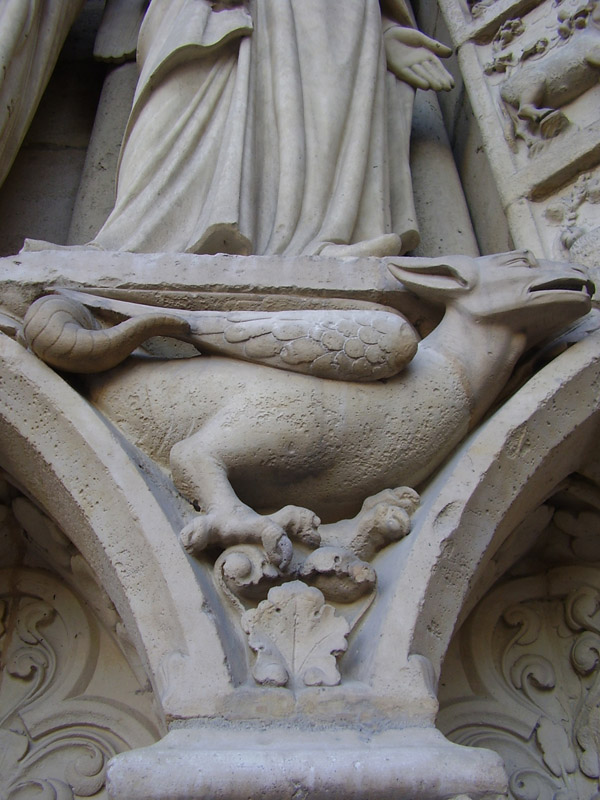
Notre Dame Dragon

Dragon carving from Notre Dame, Paris [Europe 2010]

Cathedrals are also vast and spooky spaces. They are deliberately built on an inhuman scale to impress the faithful with their insignificance in the sight of God. If the Cathedral is in any way wealthy it will be packed with tombs, statues, mosaics, alter screens and carvings, gargoyles and effigies,  crypts and relics,  all of which can be used by Keepers to instill a few harmless horrors in their players. It keeps them alert, gets the heart pumping, and does them no end of good.

Interior of Aya Sofia, Istanbul [Source: Europe 2010]

Interior of Aya Sofia, Istanbul [Europe 2010]

The Horror on the Orient Express takes place in winter, a time of early darkness, and general gloom. The shadows clustering in the nave, and thickening amid the vaults of the ceiling far overhead, may indeed be caused by the dwindling daylight, or  perhaps something more sinister.  Do the investigators wish to wait and find out? That flapping sound from the bell tower is probably just a flag blowing in the wind. Does some intrepid soul wish to climb up, and see for themselves?

Notre Dame interior [Source: Europe 2010]

Interior of Notre Dame, Paris [Europe 2010]

The writer par excellence who evoked the horror of the sacred space was M.R. James. A Cambridge don, he wrote a mere thirty ghost stories. He is the writer to read if you seek an imp in a Cathedral close,  a demon guarding an Abbot’s treasure  or a devil-haunted vicarage. The antithesis of Lovecraft, M.R. James wrote in spare, erudite prose. His ghosts are glimpsed only in snatches, generally as his terrified narrator is running for their life and sanity. His haunts are utterly malevolent. Sometimes they hunt a murderer, or avenge a theft. More often their vindictiveness is attracted  by accident. The hapless hero of  ‘Oh Whistle and I’ll Come to You my Lad’ simply blows an old whistle and is hunted by a terrible figure “with an intensely horrible face of crumpled linen”, while the luckless protagonist of ‘The Diary of Mr Poynter’ draws supernatural ire merely by making a very unfortunate choice in wall-paper.

“Oh Whistle and I’ll Come to You, My Lad” [Source: Dream Quest magazine, G.W. Thomas]

The stories of M.R. James are very adaptable to Call of Cthulhu scenarios set in England and the Continent, featuring as they do a cast of bookish dons and antiquarian  scholars. The only problem in plotting these stories as scenarios lies in their inscrutable malevolence. There is often simply no way to fend off the haunt. In other words, no way to save the haunted.

3 Comments

Filed under Travel, Writing

Venetian Ghost Stories

When I wrote about the lack of weird tales set in Venice I did not of course mean a lack of ghost stories, of which the city has plenty.  She has a Casino deli spiriti (House of the Spirits), a calla della Morte (Street of Death) and the Ca’Dario, the so-called Haunted Palace.

Venice has a plethora of ghosts,  wizards, demons, supernatural lions and stone hearts, sneezing ghosts of stillborn babies, floating coffins thoughtfully bedecked with candles so the ferries won’t run into them, and squids with human eyes. Many of these treasures are handily collected in Alberto Toso Fei’s Venetian Legends and Ghost Stories. This is my favorite kind of book. Alberto knows what we spectre-loving visitors to Venice want. He has mapped out the phantoms by district then given a walking tour of each, punctuated by pauses for increasingly more grisly stories.

Venetian Legends and Ghost Stories [Source: Alberto Toso Fei’s website]

Possibly my favorite in this collection features Doge Enrico Dandolo. Dandolo led the Fourth Crusade to the infamous sack of Constantinople in 1204, and thus links to’ The Dark Crusader’, Geoff Gillan’s new Dark Ages Horror on the Orient Express scenario. Venice appears to have always had a rather uneasy relationship with Dandalo’s memory. My trusty 1914 guide, A Wanderer in Venice, wonders why there no statues or monuments to his name. This ghost story reflects that communal disquiet. In myth, Dandolo is condemned to pace around the walls of S.S. Giovvanni e Paolo in the Castello district. With two burning coals instead of eyes, and carrying a sword by the blade, he must eternally bloody his hands to atone for the innocent blood he shed. The passer-by is advised not to try to assist this grim spectre. Any attempt to help may only add to the total sum of blood.

The S.S. Giovvanni e Paolo also holds a grisly relic, another odd link to the themes of the Horror on the Orient Express. The ill-fated Marcantonio Bragadin was one of the Venetian heroes of the siege of Famagosta in 1571. When the city was taken by the Turks, Bragadin was flayed alive in punishment for his resistance. Then his head was cut off, his body quartered, his skin was stuffed with straw and paraded around the city mounted on a cow. The stuffed skin was taken back to Constantinople as a trophy of war, where nine years later it was stolen from the Arsenal of Constantinople and returned to Bragadin’s family. The family buried the remains in a niche in the south aisle. When the niche was opened in 1961, by a family descendant, it was found to hold a lead urn containing several pieces of tanned human hide.

The monochrome fresco of Bragadin’s martyrdom above his urn [Source: Associazione Circolo della Cultura del Bello]

This fresco is exceedingly tame by comparison with contemporary 16th century portrayals of martyrdom, and was memorably snubbed by J.J. Norwich in his monumental A History of Venice as “distinctly disappointing”.

Leave a comment

Filed under Chaosium, Library Use, Writing

Other times, other Expresses II

We’re looking here at more brave, insane or intrepid individuals who have lovingly recorded their experience of running or playing Horror on the Orient Express.

Clicking any of the links below will reveal spoilers.

Bret Kramer’s blog post Memories of the Orient Express  on his blog, Tomes in Progress,  is indeed just that. He reminiscences about running the campaign through a nostalgic haze of 20-odd years, and casts a dispassionate eye over the foibles of players, Keepers and writers alike.  He also has a ton of other Keeper aids and hand-outs, and is one of the movers behind the long awaited Masks of Nyarlothoptep Companion.

Call of of Cthulhu, or Constantinople or Bust is an endearing diary version of one gang’s train journey, told in diary format by the different characters and complete with appropriately movie star photographs of the cast. I particularly like a photograph they unearthed for the Sofia  scenario. Thank you Simon, for your brave sacrifice. We fellow soldiers in the Trenches of Horror salute you. 

Simon's Eyeball [Cthulhu or Bust]

Simon’s Eyeball [Source: Constantinople or Bust]

Another 1920s version by Leonard Bottleman starts in the single calm narrative voice of Franklin Meyers, as a recap to the now scattered investigators.  However by the time the team reach Belgrade, different narrators, and a strong hint of panic, emerge. The story includes the maps and characters from the scenarios  as an aid to the reader, and as always I am in awe of how so many Keepers found so many ingenious ways to plug plot holes and keep things moving and entertaining.

Some Keepers have cleverly translated the campaign out of its 1920s roots.

Gaslight diary sets the story in 1890, and was played as a World of Darkness campaign and recorded by Derek Morton. The account is The Diary of Tweeney Sodd  and it’s a note perfect rattling easy Victorian pastiche, but its writers have used white writing on black background rendering the entire story into squint-o-vision. Copy and paste, readers, to enjoy such gems as: “I am not sure what was going on but Nigel had brought his shotgun with him.”

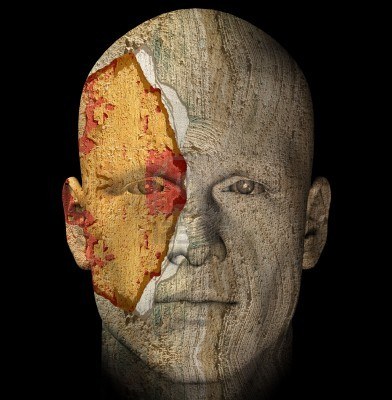
Yellow Dawn Session notes is a cyberpunk take on the Express by the seriously talented and deeply weird David J. Rodgers. It takes the Express to a sanity stretching Sofia. It also features a very classy image of the head of the Sedefkar Simulacrum.

Head of the Sedefkar Simulacrum Statue – image by sirylok

Head of the Sedefkar Simulacrum Statue – image by sirylok

So the train steams ever onward into new worlds of fantasy and imagination.

4 Comments

Filed under Guests, Writing

Terror in Venice

As the writer of Death in a Gondola for Horror on the Orient Express  it seems to me that everyone is picking up on the ghoulish gondolier theme. Terror in Venice is the upcoming expansion for the Call of Cthulhu card game from Fantasy Flight Games, and look what’s on the cover:

Terror in Venice [Source: Fantasy Flight Games]

Terror in Venice [Source: Fantasy Flight Games]

Who wouldn’t want to go for a romantic cruise through that slime-infested ooze? Although I don’t suppose that lady is enjoying the  ride. Perhaps she thinks that Deep One is after her champagne.

Fantasy Flight produce two games that Mark and I play at lot, Elder Signs and Mansions of Madness  (although I hate it when I have to solve those stupid cardboard clues). I enjoy  games involving pattern recognition but fail mightily at strategy and in chess have never really recovered from having an eight-year old beat me using Scholar’s Mate. Twice.  Elder Signs to me was the game of 2013 when the nephews went from sanity dribbling utter loss to destroying Azathoth at 9 minutes to midnight on New Year’s Eve. Also Fantasy Flight always put a capable looking woman  on the cover of their Cthulhu games, a reminder that unlike in Lovecraft’s stories, investigators are not always men.

Venice has not featured as often as you might think in the litany of weird tales.  The only novel I can think of offhand is Wilkie Collin’s ripping supernatural detective fiction crossover, The Haunted Hotel.

The Haunted Hotel by Wilkie Collins [Source: http://www.wilkie-collins.info/books]

The Haunted Hotel by Wilkie Collins [Source: http://www.wilkie-collins.info]

My favorite story, The Black Gondolier by Fritz Leiber, is set in Venice, naturally, but Venice, L.A. It features a gondolier made of primordial ooze (otherwise known as oil).  Leiber is very Lovecraftian in his weird tales as he re-casts  commonplace modern technologies in a bizarre and terrifying light.

The Black Gondolier and Other Stories [Source: Booktopia]

The Black Gondolier and Other Stories [Source: Booktopia]

So next time you’re in Venice, whether Italy or California, and a gondolier invites you for a ride, just keep an eye for tentacles sneaking out from under his jaunty striped shirt when you’re not nervously peering over the side.

Gondolas [Source: Europe 2013]

Gondolas at the Gritti Palace Hotel

4 Comments

Filed under Fun, Writing

Other times, other Expresses

We’re excited that Horror on the Orient Express has taken on a life of its own. People like it. They write about it. They create new stories and they ride the train in other times and other places. Here are a few of the brave souls who have recorded their experiences online.

Yog-Sothoth.com is a community created by Paul of Cthulhu for online discussion and friendship centered around Call of Cthulhu. It is a great place to discuss the game with fellow Keepers and frequently authors from all companies producing licensed Call of Cthulhu material. Almost all started as fans first, and writers second. Forums are clearly organized according to your Cthulhu-of-preference, Gaslight and Classic, Ancient, Modern, and all other theatres of horror.

The particular strength is the podcast recorded by Paul and friends, or Yog-radio as they style it. Years ago, the Bradford Players sat down to play through Horror on the Orient Express in its entirety, and they recorded the playthrough in surround-sound. It’s like a radio play with occasional dice. It was also collected as Lovecraftian Tales from the Table, which also includes their playthrough of Masks of Nyarlathotep as well as tons of nifty extras such as props, trailers, music and more, including interviews, one of which is with the nefarious trio of Richard Watts, Geoff Gillan and Mark.

The characters played by the Bradford Players during the audio playthrough will be included as NPCs or even replacement investigators in the Strangers on the Train section of the new edition of Horror on the Orient Express.
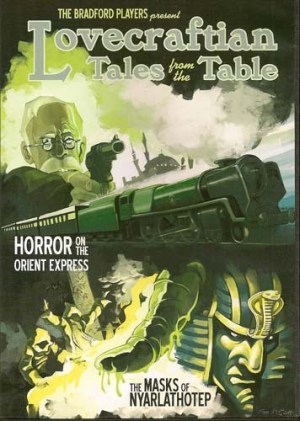
Lovecraftian Tales from the Table

Lovecraftian Tales from the Table (Yog-Sothoth.com)

 The radio play inspired Nick Marsh to create a novelization, The Express Diaries. This is a superb hardcover, illustrated by Eric M. Smith and a wonderful map by Steff Worthington. The format of the novelization is in diaries and letters.

The Express Diaries (Nick Marsh)

The Express Diaries (Nick Marsh)

When not recording bad things happening to good people on fine trains, Nick Marsh is a vet. He has a writing website which links to his amusing blog, Maybe It Should Happen To A Vet.

Finally, comic artist Jason Thompson was inspired by the podcast to do some marvelous illustrations of the characters. Jason has also illustrated Dream Quest of Unknown Kadath so he is all right by us.
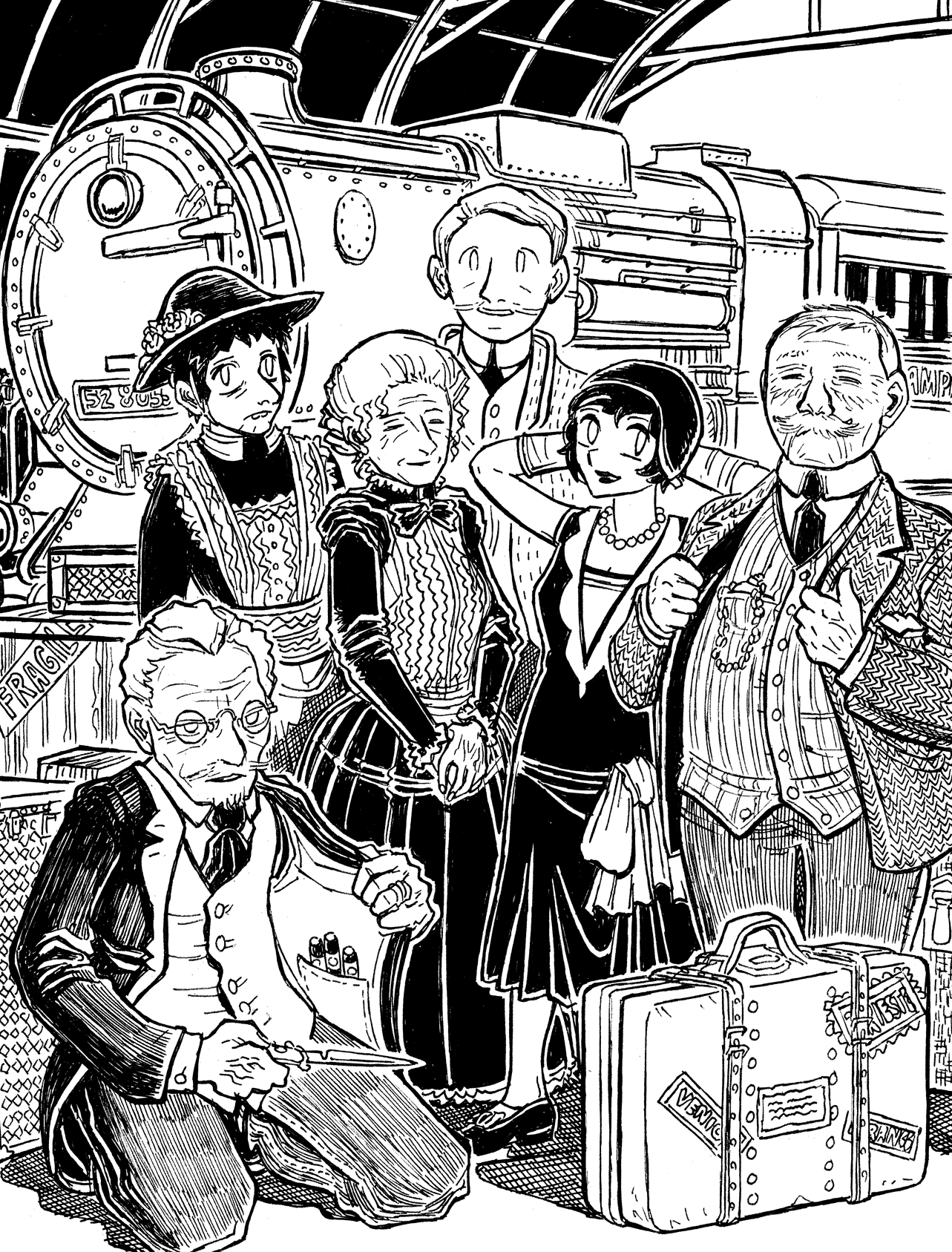
Sketch of the Bradford Players characters by Jason Thompson

Sketch of the Bradford Players characters by Jason Thompson [Source: Mockman.com]

All of this activity started with our train but really is the triumph of Paul Maclean, and everybody who posts, blogs, discusses and occasionally rants at Yog-Sothoth.com.

Leave a comment

Filed under Fun, Writing

Easter Horror on the Orient Express

Horror on the Orient Express takes place in January and February 1923, and Good Friday was on 30 March in the same year. Thus the train is eternally steaming towards Easter but never actually reaching it, which is a pity because the story is very much about rebirth and reincarnation, shedding, as it were, our human skin.  

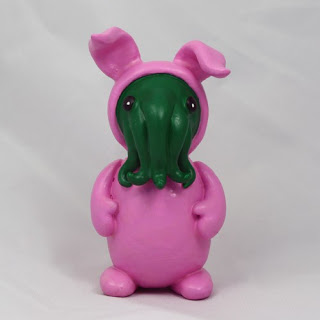
To celebrate the season I did a real quick web search for Cthulhu and Easter memes. I surfaced pop-eyed and clutching a fistful of Cthulhu bunnies.

Cthulhu as Easter Bunny

The horror…the horror… [Source: The Lovecraftsman]

I’ll be sure to thank all you energetic hobbyists just as soon as my eyeballs stop bleeding.

When horror becomes kitsch we all know the end times are nigh, although I guess what with Cthulhu cakes and Cthulhu furries we collectively splintered through that barrier a long time ago. Stop it people! For God’s sake you know not what you do. Or perhaps you do… If we mock and trivialize horror it loses its insidious power. Only when the lights are on of course; in the dark and alone, are you really sure the glassy eyes of that plush Cthulhu doll aren’t following you round the room?

Easter is, naturally, all about pagan fertility symbols. Shub-Niggurath seems the obvious fertility goddess of the Lovecraftian canon, although she rarely is mentioned beyond the standard invocation: Iä! Shub-Niggurath! The Black Goat of the Woods with a Thousand Young! (Poor Shub-Niggurath, typical superannuated female deity; the male gods take all her real power and she’s left with a placating prayer to keep her happy.)  On that note, in Horror on the Orient Express, the Belgrade chapter is even now being re-written so that… I’m not allowed to say… but just look at the start of the paragraph and fill in some holes.

However, a post-Freudian argument can be made for Cthulhu being the true symbol of renewal and fertility, albeit birthing destruction and chaos instead of redemption. There are some interpretations of  Great Cthulhu as a giant, walking uterus. This may be a useful metaphor for those who wish to delve into Lovecraft’s psyche and explore the subconscious forces that drove him to write, but I don’t think it helps us understand why we continue to enjoy the stories. Why?

We enjoy them because they scare us and we like to be scared. They scare us because they posit malevolent creatures of deity-level power inhabiting an uncaring universe in whose chinks humankind survives only because we are so insignificant we have not yet been noticed. This is a terrifying and nihilistic vision that no other writer of horror has ever evoked so completely, and it is unique. Cthulhu may be born of the subconscious fears of one man’s id, but that fear was reshaped as a terrifying and primal force that can still reach out and touch us with the very tip of one cold slimy tentacle today, decades after the stories were first written.

How’s that for a Happy Easter?

Lovecraft's sketch of Cthulhu

Lovecraft’s sketch of Cthulhu. Note lack of bunny ears. [Source: Wikipedia]

1 Comment

Filed under Fun

Revisiting Venice II – The Scenario

Beware, here be spoilers…

Re-visiting the Venice scenario made me think about the reasons why I structured it as I had. It has three strands, Love and Death, and then the Mystery, the results of the players’ investigations. On re-reading the scenario I was shocked by two things. First, my unthinking stereotyping of Italians as cheerful incompetents, for which I’d like to unreservedly apologize to the entire nation.  Second, the Venice of my imagination provided excellent background and color but it had a complete lack of actual plot – just keep knocking on those doors, players, eventually you’ll find the right house. What worked well was that the incidents of Love and Death ticked over regardless. There was always something going on in the background which the investigators could choose to investigate.

I was baffled by why I had divorced the Love sub-plot from the actual plot, until I remembered why I’d written it in the first place. In Lausanne and Milan, the players meet characters they cannot help. We wanted to restore their belief that they could save someone. This, after all, is the reason they first boarded the Orient Express. Thus, Love came in. It certainly worked a treat in the play-test. When one of the play-testers suggested not helping the lovers he was thoroughly rounded on; ‘Good God man, we’re British’ was firmly remarked.

It was clear that in my re-write I had to leave Love and Death alone and focus on building an actual plot, as well as allowing the non-player characters some more actual, well, character. Fortunately twenty additional years of writing experience have given me a few more clues on how to structure a narrative.  I’ve now moved the thing the players are trying to find around, although never fear, Dear Readers, it still ends up in the same place. I have created a trail of clues to follow, and made one of the NPCs a disabled war veteran (guess what Keepers, he has an artificial leg). In Venice the players also find a clue that sends them to Constantinople at the time of the Fourth Crusade. I feel that Venice now has more than enough plot to go on with.

It is also clear to my older self the deadly nature of the conflict between the Communists and Fascists, which my younger self had unthinkingly played for laughs. One of our play-testers is a historian, and he unearthed the following newspaper clipping. These events precede our scenario by only a few months. There are deep divisions in Venice, in all of Italy, that will only get worse.

Christmas Day fight December 1922

Christmas Day fight December 1922 [Source: Kalgoorlie Miner 29 Dec 1922, retrieved from The National Library of Australia, trove.nla.gov.au/ndp/del/article/93236637]

3 Comments

Filed under Spoilers, Writing

Opening night at La Scala

Looking at real places is always a help when running a scenario.  The Guardian website has a feature on opening night at La Scala, Milan. It’s a vivid and heartfelt look behind the scenes at La Scala, and  really sums up the central place the opera house holds in the hearts of the opera-l0ving Milanese. It will also give Keepers some ideas on how to run the Milan chapter of Horror on the Orient Express.

http://www.guardian.co.uk/travel/video/2013/feb/19/scala-opening-night-peroni-italy-video

Opening night at La Scala [Source: The Guardian website]

Leave a comment

Filed under Music

The Dreamlands Express II – The Bestiary of Dreams

When I was compiling the Dreamlands Express itinerary I thought about the fauna and flora of the Dreamlands and added it to the views from the train by way of local colour.

The fauna included Dreamlands fauna like magah birds, at least one animal of my own invention (from a dream in fact), and a smattering of real animals, mainly African. After all there are elephants and peacocks, yaks and zebras in the Dreamlands, so there must be a few other exotics tucked away. This had an unexpected side-effect. Just before Mark play-tested the Dreamlands Express scenario I found him leafing through the Dreamlands bestiary looking for quagga and okapi. I hadn’t realized it was possible to mistake these real world animals for dream beasts, but I guess their names do look kind of made up.

The okapi, a pleasingly defined “giraffid artiodactyl mammal”, is fortunately still with us:

What this okapi photograph doesn’t show you is that okapi tongues are so long  they can lick their own eyeballs  [Source: themagazine.ca August 2009]

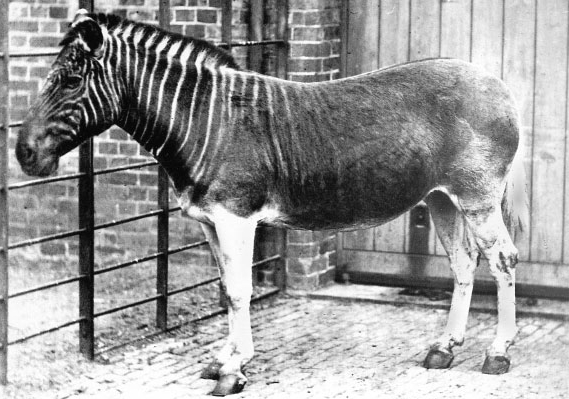
The quagga, alas, is not.

A South African sub-species of zebra, it was hunted to extinction in the wild. The last quagga died in an Amsterdam zoo in 1883. I included the quagga in the Sona-Nyl description because one of the few things we now know about the quagga – the sound of its cry – was described in a poem. As Robert Silverberg notes dryly in The Dodo, The Auk and the Oryx, it is not a good poem, but it gives us today this one useful fact. I thought that any animal immortalized in poetry should have a chance to live on in Sona-Nyl, the Land of Fancy.

Quagga in the London Zoo, 1870 [Source: Wikipedia]

The other important Dreamlands animal is of course the cat. Lovecraft loved cats and the Dreamlands was one of the few areas of his fancy where he could give this affection full play. I had great fun with a cat sub-plot on the Dreamlands Express, where cats have their own compartment and are treated as full passengers. If the dreamers ask about this, they are given reasons taken straight from Lovecraft’s DreamQuest and The Cats of UltharFor the cat is cryptic and close to strange things that men cannot see; for the Sphinx is his cousin and he speaks her language; but he is more ancient than the Sphinx and remembers that which she hath forgotten.

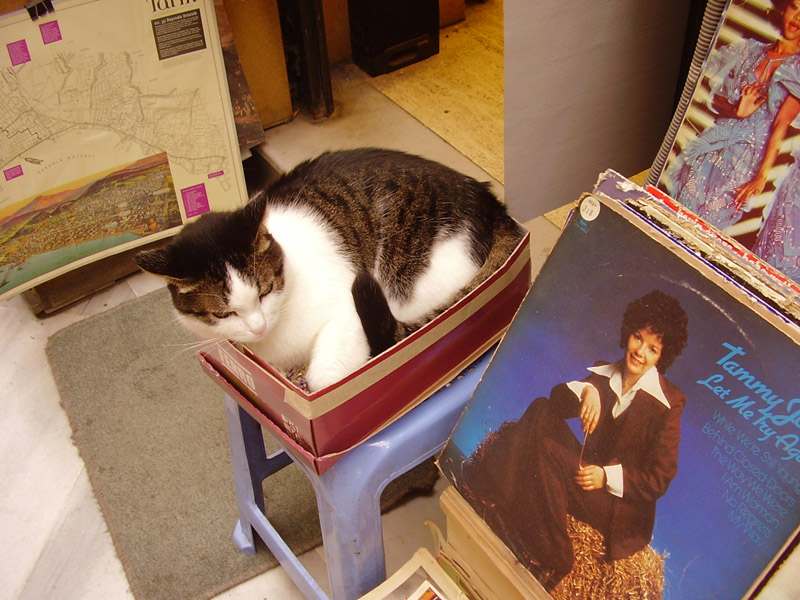
So in closing, here are some cats of Istanbul. Remember, they are looking out for you in their dreams.

Cat of Istanbul enjoying a carpet

Cat of Istanbul, ready to take a nap on a carpet

Cat of Istanbul enjoying a windowsill

Cat of Istanbul enjoying a snooze on a windowsill

Cat of Istanbul enjoying a box of records outside Lale Plak music shop

Cat of Istanbul napping in a box of records outside Lale Plak music shop

11 Comments

Filed under Writing